Logo

Logo

What is Disease X, Why do we need to be more cautious, & how to prevent it

Preyensha Srivastava |

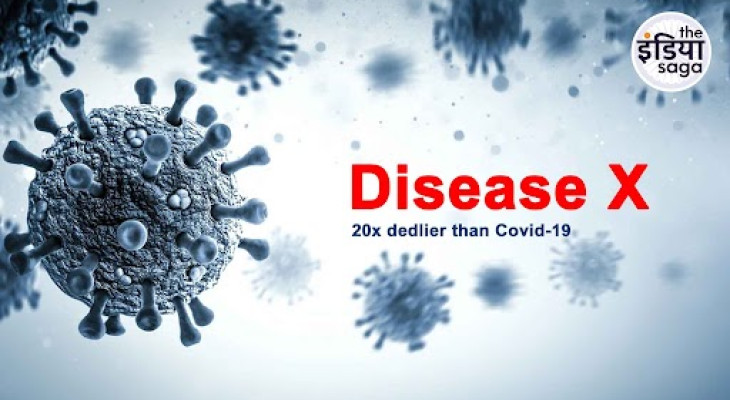
Health specialists around the world are now cautious about a potential health threat referred to as ‘Disease X,’ as the next global pandemic. The disease is spreading in the UK rapidly and creating an alarming situation among doctors, they warned if proper precautionary measures are not followed then it may kill around a million people like COVID-19. The experts stated that COVID-19 is just a presentation of what the world can feel in the upcoming years. The World Health Organisation (WHO) also contemplated the issue and added the disease to its priority list. The Global Organisation for Health Measures classifies ‘Disease X’ into the categories of  Nipah, Zika, COVID-19, Ebola, Lassa fever, and Middle East respiratory syndrome (MERS), which have already scared the world. 


What is Disease X?


It is probably and likely to be caused by pathogen X. It may be associated with a zoonosis, possibly an RNA virus originating in an area where transmission is facilitated by the epidemiological triad – environmental host. These emerging/re-emerging z-pathogens can be marked with an X and represent a threat that requires intensive and continuous active monitoring and surveillance. 


How to Prevent?


Isolation and mitigation strategies include the development and implementation of consistent international guidelines for containing bioterrorism. Immediate and appropriate travel restrictions, including strict airport controls, must be implemented to prevent the spread of Pathogen X across borders. It also requires the cooperation of global leaders, scientists, epidemiologists and infectious disease experts to investigate, control and eliminate Disease X. Extensive and mass testing, surveillance and aggressive contact tracing are potentially effective tools for timely containment of outbreak situations.


UK’s Roadmap


In response to the threat of Disease X, scientists in the UK launched the development of vaccines targeting this unknown but potentially deadly pathogen. More than 200 scientists are involved in this research, which is being carried out at the Porton Down high-security laboratory complex in Wiltshire. They are also focusing on research, primarily on zoonotic pathogens, and animal viruses that can infect humans and spread rapidly around the world. Pathogens under consideration include bird flu, monkeypox, and rodent-borne hantavirus.

Ind vs. Aus: Can India clean-sweep the Kangaroos?

Preyensha Srivastava |

The Aussies have travelled to India for their last ODI series before the Cricket World Cup, starts on October 5. In the series that commenced on 22nd September, two out of the three matches were played. The hosts (India) are two nil up in the series, making the last match a dead rubber. India, who had announced two different squads for the ODIs, have a chance to clean-sweep Australia, as the key players return to the team. 


India escalated to the first spot after the Men in Blue bashed the Australian team in the first two ODIs. In the first ODI, Indian batters showed class and aggression as they chased a target of 277 with more than an over to spare. While in the second match, India batting first scored a mammoth 399 runs in their quota of 50 overs. Australia surrendered against the fiery Indian bowling unit. 


As the veterans Virat Kohli and Rohit Sharma return for the third ODI, India will have to make some changes in the winning combinations. For the third one-day, Captain Rohit Sharma, star batter Virat Kohli, and Kuldeep Yadav will return to the squad. Mukesh Kumar, Tilak Varma, and Gaikwad have been excluded from the team as they will soon fly to China to play in the Asian Games, Prasidh Krishna has also been kept out. The probable eleven for the hosts will incur major changes.


The playing eleven for the host will be Rohit Sharma opening the batting with Ishan Kishan, in place of Rituraj Gaikwad. Virat Kohli will be batting at number three, the position at which Iyer batted in the previous ODIs. Iyer would be in at four followed by KL Rahul. For the number six spot, the team may go with the 360 master Surya Kumar Yadav. Kishan, who can also keep wickets, will provide a left-handed batting option in the top order. Surya on the other hand, can hit the ball in all directions and is in good nick. Jadeja would provide some depth to the Indian batting as he comes in at seven and a proper. 


Choosing both Kuldeep and Ashwin would be the only option for the team, as the team will be resting Shami and Pandya. Ashwin is a handy right-handed batter and is a clever finger-spinner. While Kuldeep has been in sublime form, he may need some game time before the World Cup. The team would certainly look to include Siraj and Bumrah. 


According to records, Rajkot Wicket has always hosted high-scoring encounters. India has played only three ODIs at this venue, and the team batting first has emerged to be victorious on all three occasions. The wicket generally has something to offer for the spinners, batting collapses are rare, and anything above 300 runs is considered to be above average. There have been no instances where the opening partnership in ODIs at this venue has been less than 70, so losing the toss and bowling first may prove to be costly here. India would most likely go for clean-sweeping the mighty Australians.


Sri Lanka beat Australia in the Finals & changed the approach of ODI Cricket

Preyensha Srivastava |

Pakistan emerged as the winner of the 5th edition of the Cricket World Cup, which increased the popularity of cricket in the sub-continent and the grand event of the sport returned to the sub-continent after 9 years. The three biggest giants of Asian cricket are ready to host the 6th edition of the ODI World Cup. The edition is remembered as the founder of the biggest sporting rivalry across the globe, the mother of all battles (India vs. Pakistan) changed its template in this sixth edition. The two Asian teams were facing each other for the 2nd time, but this time a heated argument between Saeed Anwar and Venkatesh Prasad, gave birth to a new rivalry. 


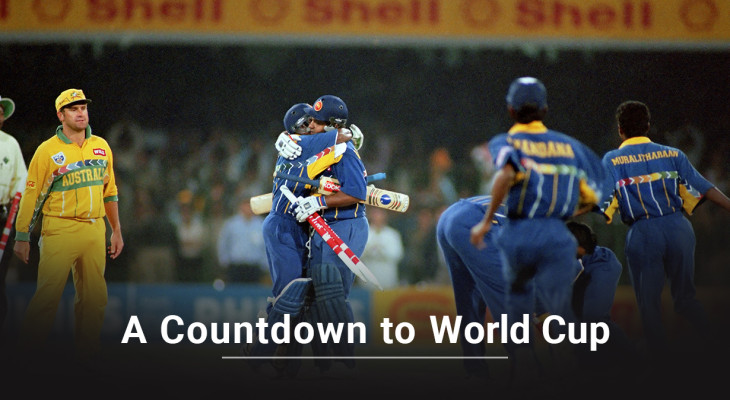
In continuation to our series ‘A Countdown to World Cup’  today we are sharing the stories of the 1996 World Cup with you. 


World Cup of 1996


The 1996 Cricket World Cup was also called the Wills World Cup 1996, because of sponsorship. All Test-playing nations took part in the competition, including Zimbabwe, who became the ICC’s ninth Test status member since the last World Cup. Three fellow teams (previously one) that qualified through the 1994 ICC Trophy were the United Arab Emirates, Kenya and the Netherlands, which made their World Cup debuts in 1996. The Netherlands lost all five matches, including the loss to the United Arab Emirates, while Kenya pulled off a surprise win over West Indies in Pune. 


Format


The format of the edition was, 12 teams were divided into two groups, where each team played once against the others in a 50-over game. The top four teams in each group advanced to the quarter-finals, where the four winners advanced to the final, followed by the finals. Matches were played during both the day and evening, teams appeared in coloured attire and used the traditional ODI white ball.


Group A

Group B

Sri Lanka

Pakistan

Australia

New Zealand

India

South Africa

West Indies

England

Zimbabwe

UAE

Kenya

Netherlands


Quarter Finals 


Matches

Results

England vs Sri Lanka

Sri Lanka won by 5 wickets

India vs Pakistan

India won by 39 runs

West Indies vs South Africa

West Indies won by 39 runs

New Zealand vs Australia

Australia won by 6 wickets

Semi-finals 


Sri Lanka unceremoniously defeated India in the first semi-final at the Eden Gardens in Kolkata in front of a crowd of 110,000. India won the toss and elected to field, having lost both their openers cheaply, Sri Lanka counter-attacked under Aravinda de Silva and overcame a heavy defeat. India started the chase promisingly but after the loss of Sachin Tendulkar, India’s batting order collapsed. After India was reduced to 120 for 8 in the 35th over, a section of the crowd started throwing fruits and plastic bottles on the pitch. The players left the field for 20 minutes to try to silence the crowd. When the players returned to play, more bottles were thrown onto the field and fires were lit in the stands. The match referee, Clive Lloyd, awarded the match to Sri Lanka, which is by default the first Test or One Day International. 


The second semi-final was played between Australia and West Indies at Mohali, Australia won the toss and elected to bat first. Australia recovered from 15/4 to post 207/8 in 50 overs. In reply, West Indians reached 165/2 in the 42nd over before losing their last eight wickets for 37 runs in 50 balls and ended up losing the game by 5 runs. 


Finals


Sri Lanka won the toss in the final and sent Australia to bat despite the team winning all five previous World Cup finals batting first. Mark Taylor (74 off 83 balls, 8 fours, 1 six) and Ricky Ponting (45 off 73 balls, 2 fours) shared 101 runs. However, after the dismissal of Ponting and Taylor, Australia slumped from 137/1 to 170/5 as Sri Lanka’s famous four-pronged spin attack took its toll. Despite the slump, Australia struggled to 241/7 from their 50 overs. Sri Lanka won the match in the 47th over with Aravinda de Silva behind his 3/42 to score an unbeaten 107 to win the man of the match award. It was the first time that the host or hosts of the tournament won the Cricket World Cup.

Statistics 


Top Run Scorer

Players

Matches

Runs

Average

Highest

Sachin Tendulkar

7

523

87.16

137

Mark Waugh

7

484

80.66

130

Arvinda de Silva

6

448

89.60

145

Gary Kristen

6

391

78.20

188*

Saeed Anwar

6

329

82.25

83*

Top Wicket Taker

Players

Matches

Wickets

Economy

Best

Anil Kumble

7

15

4.03

3/28

Waqar Yunus

6

13

4.68

4/26

Paul Strang

6

12

4.55

5/21

Roger Harper

6

12

3.77

4/47

Damian Flaming

6

12

4.87

5/36


The first Equestrian Gold for India in 41 years at the Asian Games 2023

Preyensha Srivastava |

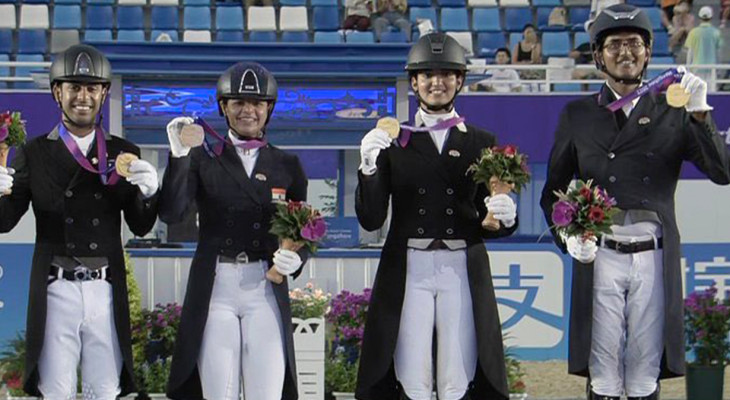
History was created by the Indian Equestrian team as they brought the gold home for the first time in 41 years. The dressage team including Sudipti Hajela, Divyakriti Singh, Hriday Chheda and Anush Agarwalla made the nation proud on Tuesday in Hangzhou, People’s Republic of China. The horses of the Indian team had a combined score of 209.205, giving India its first gold in the sport in 41 years. At the 1982 Games in New Delhi, Raghubir Singh won gold in this event, while his last medal in dressage, a bronze, came in 1986. On the third day of the 2023 Asian Games, India bagged its third gold medal as the equestrian team secured the highest podium finish in dressage.


Netizens filled the social media with warm wishes of congratulations to the team. Sachin Tendulkar, Shivendu Adhikari, and Sanjay Kapoor are some of the celebrities who came out on X to celebrate the victory. After the medals were distributed and the National Anthem was played.


PM Modi wrote on X “It is a time of uttermost glory that after several decades, our Equestrian Dressage Team has won Gold in the Asian Games! Anush Agarwalla, Hriday Chheda, Divyakriit Singh and Sudipti Hajela have shown extreme abilities and teamwork bringing pride to India on the international stage. I extend my heartiest congratulations to the Team for this historic achievement.” 


The victory of the Indian team was particularly significant because it defeated the popular Chinese and Japanese teams. China finished second with a commendable score of 204.882, but it was not enough to match the brilliant performance of the Indian riders. The Japanese team, also considered a strong contender, faced stiff competition and ultimately missed the podium. This historic victory is a testament to the dedication, hard work and talent of the Indian equestrian team. The Team Dressage event requires a harmonious partnership between rider and horse, the key elements of which are precision, discipline and grace. Indian riders exhibited all these qualities and took their performance to the highest level.

Justin Trudeau faces backlash for inviting a Nazi soldier to Canadian Parliament

Preyensha Srivastava |

Canada’s Prime Minister Justin Trudeau is facing backlash across the world for inviting a Nazi soldier Yaroslav Hunka to Canadian Parliament and giving a standing ovation to him. Yaroslava Hunka was involved in the Jewish massacre and was part of the holocaust during the Second World War. After supporting the Khalistani terrorists this is the second unacceptable act done by the Canadian PM in the last 10 days. Yaroslava Hunka was a soldier of the 14th Waffen Grenadier Division of the SS (a Nazi division). The incident occurred when Ukrainian President Volodymyr Zelensky visited the Canadian Parliament and speaker of the parliament Anthony Rota honoured the 98-year-old Ukrainian immigrant. The recognition came after a visit by Zelenskiy when he thanked Canada for its help in his country’s war against Russia. 


The actions of the Canadian parliament are facing global outrage from the leaders and diplomats from different parts of the world. Canadian opposition leader Pierre Poilievre apologised to the world and criticised Trudeau. “The Prime Minister’s personal protocol office is responsible for organising and vetting all guests and planning such state visits. We feel ashamed by this act of inhumanity,” Poilievre said. In addition, the speaker of the Canadian Parliament also apologised for firing Yaroslav Hunka, a Ukrainian veteran who allegedly fought for the Nazis during World War II. 


The Kremlin said it was “reasonable” that a Ukrainian man who served in one of Adolf Hitler’s Waffen SS units during World War II was presented as a hero in Canada’s parliament. 98-year-old Jaroslav Hunka received two applause from Canadian lawmakers during the visit of Ukrainian President Volodymyr Zelensky. Kremlin spokesman Dmitry Peskov said 

“The episode showed disrespect for historical truth. The memory of Nazi crimes must be preserved.” He added “Such disregard for memory is scandalous. Many Western countries, including Canada, have raised a young generation that does not know who fought with whom or what happened during the Second World War. Canada knows nothing about the threat of fascism,” Dmitry Peskov. 


Anthony Rota presented Yaroslav Hunka as “a Ukrainian Canadian war veteran of World War II who fought for the independence of Ukraine against the Russians.” He said, “A hero of Ukraine is a hero of Canada.”  During World War II, when Ukraine was part of the Soviet Union, some Ukrainian nationalists joined Nazi units. According to the Simon Wiesenthal Center, a Jewish human rights organisation, Jaroslav Hunka served in World War II as a member of the 14th Waffen Grenadier Division of the SS.

Asian Games: Indian women make the country proud

Preyensha Srivastava |

The Indian women faced off against Sri Lanka in the finals on Monday. In the final, the Indian Women’s cricket team defeated the Lankans to claim the Gold Medal for the country. The Women in Blue started their campaign in the Asian Games on a positive note, as they defeated Bangladesh in the semi-finals after a washout in the game against Malaysia. The win in the finals has led to a second gold medal for India in this edition of the Asian Games.


India won the toss and elected to bat with a strong batting lineup including Smriti Mandhana, Shafali Verma, and Jemimah Rodrigues, The Indians were confident of setting up a humongous target. The batting suffered an early blow as opener Shafali Verma got stumped at the score of 16 on the board. Despite losing an early wicket, Rodrigues and Smriti kept the scoreboard ticking. With four boundaries and a six Mandana was looking in perfect touch but fell prey to Ranaweera’s left arm spin on 45. Soon wickets started to fall, and as India suffered a batting collapse, they went from 89-2 to 116-7, setting a target of 117 for SL.


In a low-scoring tournament, this was a par score. The Indian bowling unit, led by the 19-year-old Titas Sadhu, troubled the Lankan top order. Due to a magical spell of Medium pace by Sadhu, the first three wickets fell with only 14 on the board. The Indian team, which was off to a flying start, was now struggling for wickets because the partnership between de Silva and Parera grew to 36. India fought back, as Gayakwad and Vastrakar dismissed both the batters. Sri Lanka only managed to score 97 runs in 20 overs. 


India claimed yet another gold, as they defeated Sri Lanka in yet another final of a multi-nation tournament. The golden run continues for India in the Asian Games as they have claimed 11 medals in total in just three days of the tournament. 

Read more about India’s Asian Games medal on: https://theindiasaga.com/sports/asian-games-indian-youngsters-claim-first-gold-for-the-country

PM Modi unveiled 72 feet statue of Pandit Deen Dayal Upadhyay in New Delhi

Preyensha Srivastava |

On Monday PM Modi unveiled a 72 feet statue of Pandit Deen Dayal Upadhyay in New Delhi on the occasion of Antyodaya Diwas. The brass statue was installed in a park named after Upadhyaya, opposite the BJP headquarters at Deen Dayal Upadhyay Marg in New Delhi, as September 25 is the birthday of Pandit Deen Dayal Upadhyaya, who formulated the political doctrine of Jan Sangh. The sculpture depicts Upadhyaya in his traditional attire, including a kurta, dhoti and a sleeveless jacket. Artisans worked hard for months to make this statue.


After unveiling the statue PM Modi paid floral tribute to Pandit Deen Dayal Upadhyay and said “The life of Pandit ji inspired all of us, we follow his guidance to help the poor and marginalised.” 


Life of Pandit Deen Dayal Upadhyay


Pandit Deen Dayal Upadhyay was born in Mathura in 1916, he was not only associated with the RSS but also played a key role as one of the founding members of the Jan Sangh. In 1948, he launched ‘Panchjanya’, which is still the official mouthpiece of the Rashtriya Swayamsevak Sangh (RSS). Prime Minister Modi has often endorsed Upadhyaya’s ‘holistic humanism and Antyodaya’ (upliftment of the disadvantaged) as the guiding principles of his government’s social initiatives. At internal party meetings, leaders like Amit Shah and JP Nadda often referred to Upadhyaya’s remarkable journey from foot soldier to party president.


Antyodaya Diwas


Antyodaya Diwas is celebrated every year in India to celebrate the birthday of Indian leader Pandit Deendayal Upadhyaya. It is a day of remembrance and celebration of his life and legacy and he was one of the most prominent figures in Indian political history. He was the founder of the Bharatiya Jana Sangh (BJS) and a thinker of the Rashtriya Swayamsevak Sangh (RSS). Upadhyaya is also known for his efforts to uplift the poor and less fortunate, thus his birthday is celebrated on Antyodaya, which means “resurrection of the latter.”


In another event organised by the Integral Humanism Research and Development Foundation in Vijayawada, Governor of Telangana Tamilisai Soundararajan, said, “People who read Upadhyaya, one of the founders. Bharatiya Jana Sangh and proponent of Integral Humanism knows how to live a dignified life.” Tamilisai Soundararajan was the chief guest at a program on Monday to celebrate the 107th birth anniversary of Deen Dayal Upadhyaya.

Canada asks citizens to stay aware and vigilant

Preyensha Srivastava |

In the middle of the diplomatic tussle Canada issued a travel advisory on Monday for its citizens in India and ordered them to “stay watchful and aware.” The decision comes after the protest and outrage against Canada has increased on social media. According to the Canadian government, the decision comes in the context of recent events between Canada and India which fuels protests on social media and somewhat negative attitudes towards Canada. Due to the recent events between Canada and India, there have been calls on social media to protest and cast a negative light on Canada. The government asked citizens to be vigilant and cautious.” 


The Canadian government’s decision comes after New Delhi issued a similar advisory to Indian citizens living in Canada and also suspended visa services last week. India has urged all its citizens living in Canada and those considering travelling there to exercise “extreme caution” amid a rise in anti-Indian activity and “politically intolerable” hate crimes in the North American country that is happening because of a diplomatic dispute over the killing of one person. The Khalistan separatist leader threatened to snowball into a major confrontation. 


The National Investigation Agency released two lists of 54 persons with their photographs who were wanted in the investigation of two cases registered last year aimed at busting terrorist gangster networks in the country. The NIA shared the lists, one with 11 people and the other with 43, on its official account on X, formerly known as Twitter. The Indian government will also revoke more than a dozen Overseas Citizenship of India (OCIs) for their positive activities and anti-Indian propaganda in Khalistan, two people familiar with the development said, citing the Mint on Sunday. from the sources. 


The diplomatic disagreement between the two nations arose, when Canadian PM Justin Trudeau made some serious allegations about India, claiming that an “Indian secret agency is involved in the killing of Harshdeep Nijjar a Khalistani terrorist in Canada.” Following this Canada has suspended the senior official of India. In reply to this India summoned the Canadian Ambassador and asked him to leave India within five days.

Cauvery Water Dispute arises, causing the “Bengaluru Bandh” in Karnataka

Preyensha Srivastava |

The District Magistrate Dayananda K.A.  confirmed that all the schools and colleges will remain closed because of the “Bengaluru Bandh”. The Organizations of farmers and pro-Kannada groups have called for a “Bengaluru Bandh” from 6 am to 6 pm on 26th September as a sign of protest against the “Cauvery Water Dispute” or the release of Cauvery water from Karnataka to Tamil Nadu. The protest-led Bandh will cause a lot of hardships for the people of Bangalore.


Normal life in the city will be affected as ATMs, schools, colleges, government offices, banks, shops, restaurants, and public as well as private transport are expected to be put to a halt. However, emergency services like hospitals, Petrol Pumps, Medical shops, etc. will function normally. For the prevention of riots and enforcement of law and order in the state section 144 has been enforced in the state. The state police tweeted, “Today addressing press, @CPBlr has reiterated that no bundh/protests/processions are allowed as per Supreme Court/High Court instructions. Section 144 enforced citywide – gatherings of more than 5 people are not permitted. Dial 112 for any help. Additional police will be deployed to maintain law and order” and inform about the situation.


The Cauvery River Dispute has been a major concern for the two South Indian states, Karnataka and Tamil Nadu, which arrived over the issue of sharing of the water from the Cauvery River, the issue traces its roots from as early as 1894. The reason why this year-old dispute has again come to the limelight is the decreased amount of rainfall in the Cauvery Basin area, leading to a water dearth. The Tamil Nadu government for that reason took the matter to the Supreme Court, demanding the Karnata reservoirs release water of  24,000 cubic feet per second volume.

The Deputy CM of Karnataka DK Shivakumar announced the release of 10 tmcft of water to Tamil Nadu. However, he discouraged TN’s move to approach the Apex court and appealed to the CWMA to take another look at the decision made regarding the Water scarcity in the state.

1992 Cricket World Cup: The Unpredictable Pakistanis

Arsh Verma |

The 1992 World Cup was the first time the tournament took place after five years instead of four. India, who won the Cricket World Cup in 1983, hosted the 1987 edition of the tournament. Continuing the tradition, the venue of the World Cup was shifted to Australia and New Zealand for the 1992 edition. This was the first edition of the tournament that was held in the Southern Hemisphere and was also the first time that South Africa participated.

In continuation to ‘A Countdown to World Cup’ series, today we will take a look at how underdogs Pakistan beat England to claim their first World Cup title.


The World Cup of 1992

The Cricket World Cup 1992 (Benson & Hedges World Cup 1992) was that edition of the World Cup where many things happened for the first time, one of them being the inclusion of Colorful kits instead of whites, and white balls instead of red cherries. The Championship took place between 22 February 1992 to 25 March 1992 in the Oceanic countries of Australia and New Zealand. New Zealand, England, South Africa, and Pakistan qualified for the semi-finals.


Format

There was a certain change in the format of the championship, rather than dividing eight teams into two groups of four, a round-robin format was adopted for nine teams playing. This meant that all teams played against every team, and the top four would qualify for the semis. 


Semi-Finals

In the first semi-final, Pakistan faced New Zealand. NZ, who were favorites to win the match and secure a place in the Final, elected to bat first. A 100-run partnership between captain Martin Crowe and Ken Rutherford accelerated New Zealand to 262 runs, setting a massive 263-run target. New Zealand captain, Martin Crowe got injured while he got out in the first Innings. John Wright was selected as the stand-in captain and this proved to be a mistake. Pakistan was off to an okayish start, and a couple of quick wickets brought Inzamam-ul-Haq to the crease. The young right-hander smashed 60 runs off 37 balls, taking victory away from the Black Caps. Pakistan accelerated to the finals.

In the second semi-final, England faced South Africa. A match rather remembered for the controversial rule, was played at the famous SCG. England batting first, scored 252/6 because of a masterful innings from Graeme Hick, who was later awarded the Man of the Match for his 83 off 90. South Africa came in to bat and was off to a good start and was on their way to chase the target. The match was equally spaced, when SA required 22 runs off 13 balls, till the rain interrupted. With the help of the most productive overs method, the target was revised to 22 off a single delivery, making the match one-sided. The controversial system was then replaced by the DLS, after the World Cup in Australia. England qualified for the Final against Pakistan.


Final

An in-form English team took on Pakistan, in the World Cup Final of 1992. Pakistan batted first and lost two early ones. Imran Khan, who was playing his last match, partnered along with Javed Miandad to rebuild the innings. The two batters batted for approximately 31 overs and scored 139 runs. Inzamam and Wasim Akram also joined the party and brought Pakistan to 249 runs. England chasing a 250-run target, fell prey to Wasim Akram’s swing and pace. Akram, along with Javed and Mushtaq bundled out England 227. Making the Men-in-Green, World Champions for the first time. This was the Dream tale of Pakistan’s road to victory, and how it rose from the bottom to become the Champions of the world.


Statistics


Top Run Scorers 


Player 

Matches

Runs 

Average

Highest

M. Crowe

9

456

114.00

100*

J. Miandad

9

437

62.42

89

P. Kirsten 

8

410

68.33

90

D. Boon

8

368

52.57

100

R. Raja

8

349

58.16

119*

Top Wicket Takers 


Player

Matches

Wickets

Economy

Best

W. Akram

10

18

3.76

4/32

I. Botham

10

16

3.43

4/31

M. Ahmed

9

16

3.98

3/41

C. Haris

9

16

4.73

3/15

E. Brandes

8

14

5.05

4/21