Logo

Logo

Iranian warship Alborz enters the Red Sea

Houthi rebels in Yemen, who are aligned with Iran, launched a barrage of missile and drone attacks against merchant vessels, forcing shipping companies to halt passage through the now heavily militarized region. In response, the United States established a multinational naval task force for the Red Sea.

TheIndiaSaga Team |

According to Iran’s Tasnim news agency, Iranian warship Alborz has entered the Red Sea through the vital Bab al-Mandeb Strait at a time when tensions over the vital waterway are running high.

The news agency on Monday, stated “the Alborz destroyer entered the Red Sea… by passing through the Bab al-Mandeb” waterway at the southern tip of the Red Sea, connecting with the Gulf of Aden in the Indian Ocean.”

Furthermore, it stated that since 2009, Iran’s naval forces have been conducting operations in the region “to secure shipping lanes, and repel pirates, among other purposes.”

Early in December, the Houthi rebels in Yemen, who are aligned with Iran, launched a barrage of missile and drone attacks against merchant vessels, forcing shipping companies to halt passage through the now heavily militarized region. In response, the United States established a multinational naval task force for the Red Sea.

The Houthis claim that the strikes were carried out in support of the Palestinian people in the besieged Gaza Strip, where Israel has been bombarding the area for months.

The Red Sea offers a detour around Africa through the Suez Canal, and 12 percent of world trade passes through it, according to the International Chamber of Shipping.

The Tasnim report was released the day after Houthi rebels in Yemen claimed ten fighters had been killed when US Navy helicopters opened fire on them as they attempted to board a cargo ship.

The UK makes a “direct action” threat

Iran deploying a warship to the area, according to Al Jazeera’s Resul Serdar, who is reporting from Djibouti, is not a “new” development. He said that Iranian warships have “occurred from time to time” in this region.

According to Serdar, “more and more warships,” including US and British vessels, are currently assembling in the area. The state-run news agency IRNA, Iran’s chief security officer, Ali Akbar Ahmadian, met with the head of the Houthi negotiations, Muhammad Abdulsalam.

The meeting’s location and timing are unknown, but Ahmadian was quoted by Iranian media as saying Tehran commended the Houthis for standing up to Israel and supporting the Palestinians.

In order “to deter threats to freedom of navigation in the Red Sea,” the United Kingdom was “willing to take direct action” against the Houthis, as per Britain’s Defense Secretary Grant Shapps on Monday. Red Sea tensions were discussed by British Foreign Secretary David Cameron and his Iranian counterpart Hossein Amir-Abdollahian on Sunday.

He stated on social media that Tehran has “long-standing support” for the Houthis and that “I made clear that Iran shares responsibility for preventing these attacks.” According to a statement from Iran’s foreign ministry, Abdollahian criticized the “double standards” of some Western nations, saying that the Gaza war was a sign that the “Israeli regime cannot be allowed… to set the region on fire.”

Iran was previously charged by the US with having a “deeply involved” role in the Houthi attacks. Iran has refuted these claims, claiming that the Houthi rebels were operating independently. In the Gulf of Aden in 2021, the Alborz thwarted a pirate attack on two oil tankers.

Furthermore, it was one of two Iranian warships that were deployed to the strait in 2015 “to ensure the safety of commercial ships,” a move that at the time was interpreted as an indication of hostilities with Saudi Arabia.


11 Interesting and Unknown Facts about Ram Mandir

The consecration of the idol of Ram Lala will take place on 22 January 2024 in Ayodhya. As the clock ticks and time gets closer, everyone is curious about what will happen and what the Ram Mandir will look like.

TheIndiaSaga Team |

Ayodhya is one of the most sacred cities in the history of Sanatan Dharma. The religious city is known as the birthplace of lord Ram, and it has been considered the first of the seven most important pilgrimages for Hindus. Everyone knows that the Ram Janmabhoomi issue of Ayodhya was in dispute for a long time. The Supreme Court on 9 November 2019, determined that all the disputed land belongs to the Ram Janmabhoomi Teerth Kshetra Trust. After which on 5 August 2020, the Prime Minister of India, Narendra Modi, performed the Bhoomi Pujan of the temple. 

We all know that the consecration of the idol of Ram Lala will take place on 22 January 2024 in Ayodhya. As the clock ticks and time gets closer, everyone is curious about what will happen and what the Ram Mandir will look like. So many questions are knocking on the door. So, here is the list of 11 interesting and hidden facts about Ram Mandir

11 Interesting and Unknown Facts about Ram Mandir

  1. The Ram Mandir model that has been suggested calls for a temple that is 161 feet tall at its tallest point, 270 meters long, and 140 meters wide.
  2. The temple will have five main entrances, marble flooring, and 221 pillars. There will be twelve sculptures of gods and goddesses carved into each pillar.
  3. Numerous sources claim that neither iron nor steel will be used in the construction of the Ram Mandir. The entire structure of the mandir will be made of stones, and materials like copper, white cement, and wood will be utilized in place of iron.
  4. In the temple building, about 10,000 devotees will be able to visit at the same time and receive darshan.
  5. Uttar Pradesh is classified as an earthquake-prone zone 4, and Ayodhya is classified as an earthquake-resistant zone 3, making it less likely to occur. The temple’s construction will be robust enough to withstand earthquakes with a magnitude of greater than 8 to 10.
  6. The Shri Ram Janmabhoomi Teerth Kshetra Trust, which was established in February 2020 to oversee temple construction and other related matters, will cover all construction-related costs for the Ram Mandir. Donations for the same are cordially invited from devotees.
  7. Renowned architect Chandrakant Bhai Sompura created the Ram Mandir model back in 1987. The temple will be constructed in the Nagara style, per Vastu Shastra’s precepts.
  8. There will be a time capsule buried 200 feet below the temple structure. The main purpose of placing a time capsule is to protect the identity of the temple so that it doesn’t forget in the future. 
  9. Every visitor to the magnificent Ram temple who was invited to the “Bhumi Pujan” ceremony received a silver coin as “prasad.” The image of Ram Darbar, which features Lord Ram, Sita, Laxman, and Hanuman, is on one side of the silver coin. The symbol of trust is on the other.
  10. Before the “Bhoomi Pujan” in Ayodhya, famous Indian sand artist and Padma Awardee Sudarsan Pattnaik created a five-foot-tall replica of the Ram Mandir with Lord Ram on the sand at the Puri beach.
  11. A replica of the Ram Temple will be created by renovating the Ayodhya Railway Station. Thus, even before they visit the Ram Mandir, people will already have a glimpse of it.

What is the new hit-and-run law? Truck drivers across States protest Centre’s new law

The Bumpy Road Ahead: New Hit-and-Run Law and Trucker Protests

TheIndiaSaga Team |

India’s roadways, once bustling with commerce and life, have recently become the stage for a clash between safety and livelihood. The newly implemented hit-and-run law, caused truckers to grind the highways to a stop in protest.

What is the new hit-and-run law?

The core of the new law lies with the Bharatiya Nyay Sanhita (BNS). It stipulates that drivers involved in accidents resulting in serious injury or death, who flee the scene without informing authorities, face a potential 10-year jail term and a heavy Rs. 7 lakh fine. This marks a significant increase from the previous maximum of 2 years and supports the penalties for leaving victims behind. The law’s supporters praise it for providing a much-needed deterrent against tragic hit-and-run incidents. According to their argument, tougher penalties will deter drivers from escaping, speeding up response times and possibly saving lives. A financial deterrent to reckless behavior is also provided by the large fee.

Why are truck drivers across States protesting?

However, not everyone is celebrating. Truck drivers are the very group that the law is intended to regulate, and they are deeply unhappy about it. They primarily worry about what they consider to be unclear definitions of “serious injury.” They worry that because of dark interpretations, they may be unjustly accused of minor accidents, which could result in heavy fines and unjustified custody. The drivers also highlight the difficult reality of their work. Long working hours, demanding schedules, and pressure to meet deadlines can sometimes obscure a minor accident amidst the blur of the road. They create the risk of unintended oversight, where the strain of the work could cause one to forget about an incident without intention.

Truckers are interrupting supply networks and blocking roadways as a result of this widespread protestation. Their message is crystal clear: although the law is well-intentioned, it nevertheless has to be improved to prevent putting their livelihoods in danger and unfairly penalizing unintentional mistakes. The administration must strike a fine balance between protecting public safety and calming drivers who are protesting. Tensions might be reduced by clarifying the definition of “serious injury” under the legislation and establishing strict guidelines for reporting accidents. To further close the knowledge gap, drivers could benefit from training and awareness activities on the updated legal framework.

The complex connection between responsibility, safety, and the realities of daily life is brought to light by the recently passed hit-and-run law. It is essential to come up with a solution that takes care of drivers’ legal issues and safeguards victims. Only then can the roads flow freely once again, carrying not just goods and people, but also a sense of shared responsibility and mutual respect.

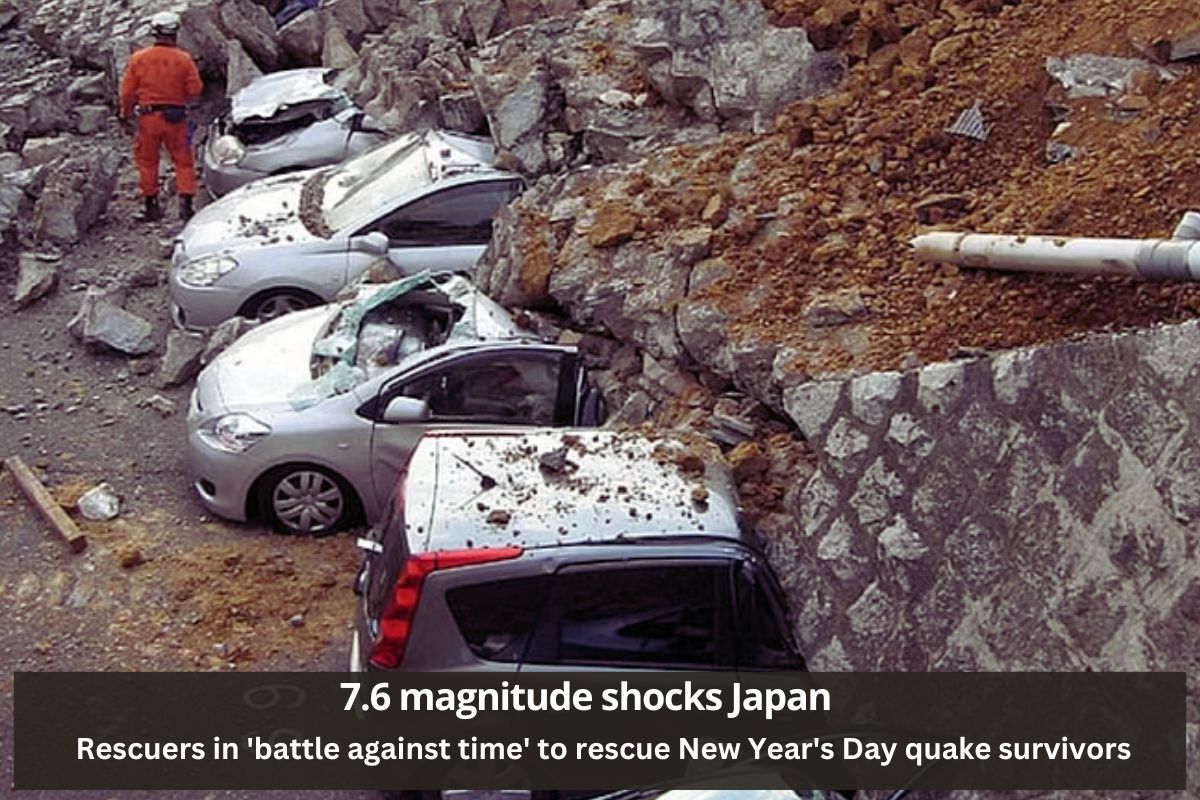
Japan Earthquake: Rescuers battling against time to rescue New Year’s Day quake survivors

Japan is rocked by a 7.6 magnitude earthquake; rescuers must “fight against time” to reach the onlooker

TheIndiaSaga Team |

The New Year happened shockingly in Japan on Monday morning. A significant tsunami warning was issued for the central prefecture of Ishikawa following an earthquake that struck a broad region along the Sea of Japan coast on Monday, disrupting the joyous atmosphere of the New Year’s celebrations. The preliminary magnitude of the earthquake was 7.6.

Japan is rocked by a 7.6 magnitude earthquake

According to the Japan Meteorological Agency, the earthquake struck at 4:10 p.m. and registered a maximum of 7.6 on the Japanese seismic intensity scale on the Noto Peninsula in Ishikawa. It also rattled buildings in central Tokyo.

A 1.2-meter-tall tsunami made landfall at Wajima Port in the area. According to the central government, there were six instances of people being buried alive in Wajima on the peninsula as a result of houses collapsing. Following the earthquake, a massive fire also started in the city, and collapsed houses were reported in several other municipalities.

The earthquake was felt across a large area, extending from the southwestern region of Kyushu to Hokkaido in northern Japan. There were advisories and warnings about tsunamis for prefectures near the Sea of Japan. According to the news agency Interfax, the Russian government issued a tsunami warning for Sakhalin’s western coastal region in the Far East in response to the earthquake in Japan.

Both South Korea and North Korea, according to local media and authorities, issued similar alerts for their eastern coastal areas.

The region of Noto, which is prone to large earthquakes, was the epicenter of the event. The meteorological department said it was very shallow. The region was still periodically shaking. 2018 saw Hokkaido record its last earthquake with a maximum Japanese intensity of 7.

The magnitude 9.0 earthquake and tsunami that struck northeastern Japan in 2011 and led to the Fukushima nuclear crisis are the reason for the first major tsunami warning to be issued.

The agency issued a warning, stating that during the next week, particularly in the coming days, areas that were severely impacted this time around could be struck by earthquakes with a seismic intensity of about 7.

In Awara, Fukui Prefecture, multiple injuries were reported, including two women who were hospitalized after falling or being struck by falling objects, according to local authorities. In Itoigawa, Niigata Prefecture, an 80-year-old woman was injured in the head after falling during the evacuation process. Approximately 32,500 homes in Ishikawa lost electricity.

Over 51,000 individuals across five prefectures were advised to leave, as stated by the Fire and Disaster Management Agency. The Defense Ministry stated that the Self-Defense Forces are responding by providing blankets, water, and food to the approximately 1,000 residents and others who were evacuated to an Air Self-Defense Force base in Wajima.

According to the central government, SDF members were asked to go on a disaster relief mission by Ishikawa Gov. Hiroshi Hase. The meteorological agency confirmed tsunamis were also seen in the prefectures of Niigata and Toyama.

After the earthquake, the Japanese government, which established an emergency response office at the prime minister’s office in Tokyo, stated that no anomalies had been reported at any of the nation’s nuclear plants. Due to the earthquake, East Japan Railway temporarily halted service on all of its Shinkansen lines, including the Tohoku, Joetsu, and Hokuriku lines.

When a tsunami warning was issued, Prime Minister Fumio Kishida advised locals to “evacuate immediately.” According to Kishida, the government will accurately notify people about evacuation, quickly determine the true extent of the damage, and collaborate with local governments to protect human life.

From Muted to Mellow: Innova Captab’s Green Surge – Buy, Sell, or Hold?

sachin |

Innova Captab’s debut on the stock market was a cautious affair, leaving investors unsure whether to cheer or jeer. But the tides have turned swiftly, with the stock swinging a whopping 21% into the green territory. Given this significant change, one may wonder if it makes sense to purchase, sell, or hold onto Innova Captab.

A Muted Debut:

Innova Captab’s initial public offering (IPO) didn’t exactly set the market on fire. The listing price was met with lukewarm enthusiasm, and the stock barely budged in the first few days. This was ascribed by analysts to worries regarding the company’s modest size and valuation.

The Green Surge:

However, the narrative took a sharp turn this week. Fueled by a combination of factors, including positive sentiment towards the speciality chemicals sector and a successful investor meet, Innova Captab’s stock rocketed 21%. This surge has left investors scrambling to assess the company’s potential and investment strategy.

Is It Better to Hold, Sell, or Buy?

The decision to buy, sell, or hold Innova Captab is a complex one, and there’s no one-size-fits-all answer. Here’s a breakdown of the factors to consider:

Reasons to Buy:

  • Strong fundamentals: Innova Captab operates in a growing market for speciality chemicals, with a focus on high-margin products. The business has a robust pipeline for research and development as well as a substantial order book.
  • Positive sentiment: The recent surge in the stock price indicates growing investor confidence in the company’s future.
  • Possibility for additional growth: Innova Captab should have plenty of potentials to grow since the speciality chemicals industry is predicted to keep growing in the years to come.

Reasons to Sell:

  • Valuation concerns: Some analysts believe the stock is already trading at a premium, making it vulnerable to a correction.
  • Volatility risk: The recent surge could be a temporary blip, and the stock could experience significant volatility in the future.
  • Limited track record: Innova Captab is a relatively young company with a limited track record. This could make it a riskier investment than established players.

Reasons to Hold:

  • Wait and see: If you’re unsure about the stock’s future, it might be best to wait and see how it performs in the coming months.
  • Long-term potential: If you believe in the company’s long-term potential, holding the stock could be a good option, even if it experiences short-term volatility.
  • Diversification: Innova Captab could add diversification to your portfolio, especially if you’re already invested in other sectors.

Ultimately, the decision of whether to buy, sell, or hold Innova Captab is a personal one. It’s crucial to conduct independent research, think about your risk tolerance, and, if needed, consult a specialist. Recall that past performance is not always a reliable predictor of future outcomes, and the stock market is by its very nature unpredictable.

Wipro’s lawsuit, former CFO Jatin Dalal violated his non-compete agreement by joining Cognizant 

sachin |

In a recent lawsuit, Wipro accused Jatin Dalal, its former Chief Financial Officer (CFO), of breaking the non-compete agreement stipulated in his employment contract. According to the terms of the agreement, Dalal must wait a full year after his resignation date before joining a competitor company.

On November 28, the information technology services major filed a lawsuit in the Bengaluru civil court against Dalal in this regard.

According to the court document that Moneycontrol was able to obtain, Wipro additionally demands that Dalal pay Rs 25.15 crore in damages in addition to 18% interest until the date of payment.

According to the Agreements, Defendant will pay Plaintiff the total number of RSU awarded multiplied by the share price that was in effect on the date of the award OR the amount that was calculated to be equal to Defendant’s gross pay for the last 12 (twelve) months of service, whichever is higher. The lawsuit stated that the plaintiff had, nevertheless, limited its claim without prejudice and in good faith. The claim is valued at INR 25,15,52,875/- (Rupees Twenty-Five Crores Fifteen Lakhs Fifty-Two Thousand Eight Hundred and Seventy-five) plus interest computed at 18% (eighteen per cent) per annum until the date of payment.

In September, Wipro informed the exchanges of Dalal’s resignation. Shortly after, it was revealed that he had accepted a CFO position at competitor Cognizant. His employment with Wipro ceased on November 30.

In a countermove, Dalal has also filed an application asking the court to send the case to arbitration. The court has heard arguments from both parties, and January 3 is the date of the upcoming hearing. Having worked for Wipro for more than 21 years, Dalal has been the CFO since 2015. He will succeed Jan Siegmund in his new position at Cognizant, as the latter intends to retire in early 2024. Dalal will answer to Ravi Kumar S, the CEO of the business.

Overseeing a range of global financial functions, including corporate development, investor relations, tax, treasury, internal audit, financial planning and analysis, accounting and controllership, and enterprise risk management, will be among his duties.

In his Cognizant offer letter, Dalal signed a statement indicating that Cognizant would not be liable for any legal ramifications from his former employer, as noted in Wipro’s complaint.

This declaration serves as my representation and warranty to Cognizant that, (I) I am entering into this agreement voluntarily, and that carrying out my obligations under it won’t conflict with any other person, business, organization, or other entity; (II) I am not bound by any terms of any agreement with any previous employer or other party to refrain from engaging in direct or indirect competition with such previous employer or other parties, in any case, that would be violated by my entering into this agreement and/or providing services to Cognizant under its terms; and (III) I have read, understood, and accepted the above offer of employment and agree to the terms and conditions stated above,” the declaration.

Wipro’s action may put Dalal’s new position at Cognizant in jeopardy. In the meantime, Wipro has experienced almost ten high-level departures in 2023 alone, as CEO Thierry Delaporte battles to turn the company around in a demanding demand climate.

Another former senior executive is the target of a lawsuit from Wipro in a US court for allegedly breaking a non-compete agreement when he joined Cognizant. Mohd Haque, the former senior vice president (SVP) and head of healthcare and medical devices for the Americas at Wipro was the executive in question.

Haque was charged by the organization for allegedly having seven files containing sensitive data that were sent from his personal Gmail account after the IT department discovered them. According to Wipro, additional files were also uploaded and sent to his email account from outside the company.

Under the radar, cognizant

While the dispute over poaching among leading IT firms has gotten more heated in 2023, Infosys has also accused Cognizant of using unethical methods to poach employees.

On December 27, Moneycontrol revealed exclusively that Infosys had written to Cognizant to dissuade the company after several of its top executives left to work for the company. One of the sources stated, “This communication to Cognizant was more of a deterrent, but non-compete clauses are not enforceable.”

Meesho Surges: 77% Growth in FY23, Profitability in Focus as FY24 Shows Strong Momentum

sachin |

Meesho, a horizontal e-commerce platform, according to its financial results posted on the company blog, experienced notable growth as its operating scale increased 77% year over year to Rs 5,735 crore in FY23 from Rs 3,240 crore in FY22. The Bengaluru-based business links suppliers with buyers on its social commerce platform and offers marketplace services like order fulfillment and delivery. Meesho announced on its blog that it had downloaded 14.5 crore apps in India in 2023 and 500 million in the first half of FY24. 

In the end, the company helped Meesho reduce losses by 48% to Rs 1,675 crore in FY23 from Rs 3,248 crore in FY22 by controlling its customer acquisition costs, infrastructure costs, and various other expenses through the use of an efficient cost mechanism. In addition to the FY23 figures, the company also disclosed its H1 FY24 results, showing that during the same period, revenue increased by 37% YoY to Rs 3,521 crore while losses decreased by 90% YoY to Rs 141 crore. According to the blog post, Meesho also stated that it has been profitable with positive cash flow in India since July 2023 and has remained so.

Meesho saw notable growth in FY23 and H1 FY24 thanks to a notable increase in scale and optimization of the selling, general, and administrative expenses. The company also mentioned the opening of Meesho Mall, Project Suraksha, and the onboarding of over 25,000 non-GST sellers in just two months as additional factors fueling Meesho’s expansion.

Meesho’s H1 FY24 financial results indicate that, with a respectable growth rate in the current fiscal year, the company is putting profitability first. Meesho asserted that since last July, it has turned a profit. When it releases FY24 numbers, however, the full picture of its profitability will be assessed.

This season, stay warm with these 10 Incredible Indian Winter Dishes.

sachin |

It’s time to swap out your light summer cuisine for warming dishes that will make you feel warm from the inside out as the crisp winter air descends over India. Indian cuisine is known for its vibrant flavours and comforting traditions, which are embodied in every bite of food, from the earthy depths of Sarson ka Saag to the sweet embrace of Gajar ka Halwa. Indian cuisine provides a wide range of delicious options to beat the cold, from hearty stews and curries to comforting sweets and porridges. Here are ten delicious winter recipes that will make you appreciate the season as you curl up with a blanket and spend time with your loved ones:

1. Sarson ka Saag: This traditional Punjabi meal consists of mustard greens cooked in a smooth tomato sauce that has a touch of spice and earthiness to it. Enjoy it with Makki ki Roti, a flatbread made of corn, for a filling dinner.

2. Gajar ka Halwa: A bowlful of this traditional winter dessert is like a warm embrace. A rich, pudding-like texture that is both comforting and indulgent is produced when grated carrots are slowly cooked in milk and ghee while being infused with cardamom and nuts.

3. Undhiyu: An exquisite winter dish, this is a vegetable casserole from Gujarat. In a clay pot, layers of seasonal vegetables such as green beans, colocasia, brinjal, and sweet potatoes are cooked with ghee and spices to create a flavorful symphony that is comforting and healthful.

4. Ragi Rotti: Made from finger millet, this South Indian flatbread is nutrient-dense and delicious. Savour it with your preferred lentil stew or sambar for a high-protein, high-fibre meal that will give you energy all day.

5. Thukpa: This hot bowl of comfort food is Tibetan noodle soup. Cooked thin wheat noodles are served with vegetables and meat, usually lamb or yak, in a tasty broth. For an extra kick, add a dollop of chilli oil, and enjoy the warmth that permeates your bones.

6. Gond Ladoo: A North Indian wintertime staple, these sweet and nutty balls are made from Gond (edible gum). The ground is shaped into balls after ghee, nuts, and spices are added. In addition to being delicious, they are thought to provide health benefits such as boosting immunity and keeping you warm.

7. Panjiri: Packed full of nutrients, this hearty porridge is made with roasted grains, nuts, and ghee. For breakfast or as a midday snack, it’s frequently served with milk or yoghurt, giving you steady energy throughout the chilly winter months.

8. Kharode Soup: Made with spices and colocasia leaves, this Maharashtrian soup is a straightforward but tasty meal. It’s a great option for a quick and cosy dinner on a cold day because it’s light and simple to digest.

9. Til Pitha: Perfectly steamed sweet rice dumplings from Assam, these are filled with a paste made of sesame seeds. The nutty sweetness of sesame seeds blends well with the warmth of winter spices to create a delightful treat.

10. Rogan Josh: A real wintertime treat, this curry of lamb from Kashmir. Elaborately spiced with cardamom, cloves, and saffron, a flavorful gravy is cooked with tender lamb pieces. You’ll feel content and the rich, creamy texture will help you fight off the winter blues.

India has an abundance of delicious winter dishes, these being just a handful. Take advantage of the season’s abundant food offerings as the weather cools off and enjoy these delectable and cosy winter treats to soothe your body and spirit.

Therefore, let this list serve as your guide for a culinary adventure through the winter wonderland of Indian food, whether you’re looking for a filling lunch, a cosy dinner, or a decadent dessert. Change up the ingredients and give these recipes a unique spin. Cooking is, after all, about making memories and spreading warmth, and there’s no better way to do those things than with a hot plate of comforting winter food.

The OG Meets the Influencer: Parle-G Makes Waves with Viral Packaging Swap

sachin |

For decades, the familiar face of a pigtailed girl on a yellow wrapper has been synonymous with childhood memories, tea-dunking escapades, and the comforting familiarity of Parle-G biscuits. But this festive season, the iconic brand took a playful detour, replacing its cherished mascot with the face of a digital age icon – Instagram influencer Zervaan J Bunshah.

It all started with a viral reel. Bunshah, known for his humorous takes and Parsi, posed a hilarious question: “If you meet the owner of Parle, do you call him Parle sir, Mr Parle, or Parle G?” The clip resonated with audiences, garnering millions of views and a witty response from the official Parle-G account: “Bunshah ji, you can call us the OG (original gangster).” 

But Parle-G didn’t stop there. In a bold move, they surprised everyone by launching limited-edition packs featuring Bunshah’s grinning face instead of the classic girl. This wasn’t just a brand stunt, it was a clever nod to the power of social media engagement and a way to connect with a younger generation of consumers. The internet’s reaction was swift and mostly positive. Many found the new packaging refreshing and humorous, praising Parle-G for their sense of humour and willingness to embrace pop culture. Some even called it a genius marketing move, generating widespread buzz and online conversations.

However, some loyal fans expressed concern about the fate of the iconic girl, fearing a permanent replacement. Parle-G quickly clarified that this was a temporary campaign, a playful wink to current trends and a tribute to Bunshah’s viral question. The girl, they assured, would remain the brand’s timeless symbol. This episode raises several interesting questions. Can iconic brands like Parle-G benefit from tapping into the influencer sphere? Does using viral trends help them stay relevant and relatable to younger audiences? And how can they balance embracing the new while preserving their cherished heritage?

The answer, it seems, lies in the execution. Parle-G’s campaign wasn’t simply about slapping a different face on their packaging. It was a witty conversation, a playful exchange that resonated with their audience. They acknowledged the digital landscape without disrespecting their tradition, demonstrating a keen understanding of brand identity and consumer sentiment. Ultimately, Parle-G’s temporary logo swap may be a blip in their long history, but it stands as a testament to their adaptability and sense of humour. It proves that even an OG can have fun, engage with trends, and remain true to its core values. And who knows, maybe in the future, we’ll see another unexpected face grace the Parle-G packet – a testament to their ability to surprise and delight us, one biscuit at a time.

Under EPFO in five years, the formal female workforce more than doubled.

sachin |

The Employees’ Provident Fund Organization (EPFO) has seen a net new addition of female employees more than twice in the last five years as businesses become more inclusive and strive towards greater gender parity. This has resulted in a surge in formal job creation for women in India since 2018–19.

According to EPFO payroll data, the net number of new female employees under the retirement fund body increased from 1.30 million in 2018–19 to 2.8 million in 2022–2023—a 120% increase.

Due to the pandemic, the number of female employees added to EPFO in 2019–20 decreased slightly to 1.39 million in 2020–21 from 1.59 million. It did, however, quickly recover to 2.61 million in 2021–2022.

Furthermore, data from the labour ministry indicates that roughly 53% of women who are unorganized workers have registered on the e-Shram portal, which is devoted to their registration and the building of an extensive national database.

According to ET, Bhupender Yadav, the minister of labour and employment, the net increase in EPFO subscriptions is a measure of how formalized the job market is for women and how many workers in the organized and semi-organized sectors are receiving social security benefits.

“It’s a continuous process, but the government has taken various steps to improve women’s participation in the labour force, to ensure their economic security and quality of employment,” he said, adding that government laws, policies, and programs specifically targeted at women have led to encouraging developments in the female labour market.

Thus, according to the Ministry of Statistics and Program Implementation’s Periodic Labour Force Survey, the estimated female labour force participation rate (LFPR) on usual status for individuals aged 15 and over increased from 23.3% in 2017–18 to 37.0% in 2022–2023.

Nonetheless, the figure pales in comparison to the global rate of female labour force participation, which the World Bank estimates to be over 50% on its gender data portal.

The labour ministry claims that various protective measures have been added to labour laws to ensure equal opportunity and a friendly workplace for female employees. These include raising the maximum length of paid maternity leave from 12 to 26 weeks and providing 12 weeks of leave to mothers who adopt children younger than three months old, as well as commissioning mothers.

Additionally, companies with fifty or more workers are required to set up a childcare facility on the property and allow women to work night shifts as long as they take the necessary safety precautions.

Furthermore, no employer shall discriminate against any employee based on gender in matters about wages in an establishment or any unit thereof regarding the same work or work of a similar nature performed by any employee. This is stated in the Equal Remuneration Act, of 1976, which is now included in the Code on Wages, 2019.