Logo

Logo

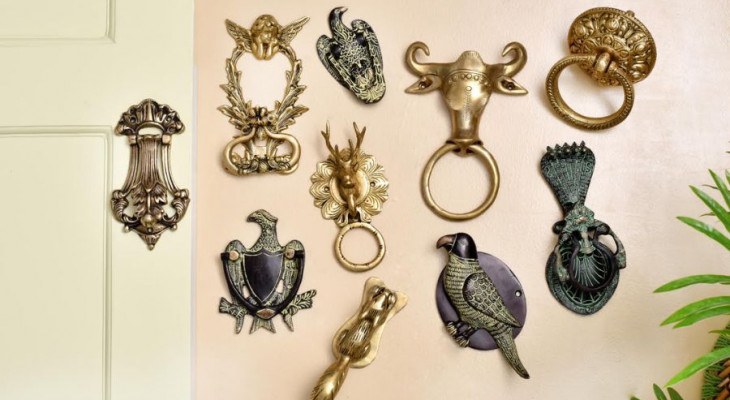
Check out the elegant collection of vintage Door Knockers from IndianShelf

The India Saga Saga |

In recent years, the trend of adorning doors with metal Door Knockers has picked up. A simple, practical door accessory, door knockers have been used in all the cultures across times wherever there has been a structured human settlement. With modernization and the invention of electric bell replaced Door Knockers around the world but now they are back in vogue.  IndianShelf presents a unique collection of metal door knockers for the festive season.


IndianShelf has a vast collection of metal Door Knockers, which are elegant, vintage and very unique. These are easy to attach to the door or any surface and are used to push or pull the door.  These Door Knockers can be used both for decoration and for practical usage. Especially if you are looking to give an artistic touch to your interiors, Door Knockers add to it.


At IndianShelf, Door Knockers come in a variety of style and material like brass, bronze, steel etc. and work well with any weather conditions.


Some of the popular categories of Door Knockers at IndianShelf are:


Lion Head Door Knockers – The Lion head Door Knockers are the most popular and are available in a variety of colors, shape and finish. From vintage looking, patina touched ones to modern looking; there is a vast collection.  They come in a variety of colors – gold, satin nickel, antique brass, weathered black and many more. Lion Door Knockers are an ideal decorative accent for a front entryway.  


Demon Head Knockers – The Demon face shape door knockers stands out for their decorative & ornate designs. Apart from being unusual, they also serve the purpose of keeping evil glance away. Most of these are flanked by a bird or an animal and are made of pure brass. An elegant vintage decor item, these come in a variety of finish and made.


Bird Door Knockers – The category of bird Door Knockers is beautiful and stands out for its unique bird shape cast. The most popular in these are woodpecker Door Knocker, Bronze parrot Door Knocker, Eagle brass Door Knocker, Antique Owl Door Knocker; Peacock engraved knockers and Ornate Green Patina Parrot Bird Door Knocker.


Decorative Door Knockers – There are also some unique and decorative options. For example, the Handmade roman design Door Knockers with a roman face in center is classic for a Victorian or European touch. The brass green patina elephant trunk is beautifully vintage and antique. Then there are antique anchor iron Door Knockers and seashell iron Door Knockers that stands out for their unique design. Available in different designs and metals, check out the full range on IndianShelf website


Wildlife inspired Door Knockers – A perfect amalgamation of art, design & metal, the animal & wildlife inspired Door Knockers can beautifully transform not just the surface or door but the entire area. At IndianShelf, wildlife – animals, insects, and reptiles – is a big inspiration and so one can see the same in this category. The popular ones includes Sitting Rabbit Iron Door Knocker, Bumble Bee & Sea Horse Door Knockers, Brass crocodile door knocker, Brass vintage Fox head knocker, Horse, bull & sheep door knockers.


About IndianShelf

Indianshelf sells home decor items online. It ensures all the products portray the beauty and diversity of traditional Indian arts. The company connects more than 5,000 rural artisans to contemporary urban markets, laying the groundwork for skilled, long-lasting rural employment.


Indianshelf strives to establish direct communication between customers and artisans, allowing them to collaborate efficiently and economically. Our products are eco-friendly, handcrafted, trendy, and reasonably priced.

Travel Planners – The Perfect Inbound Travel Planning Agency

The India Saga Saga |

Travels are always an indispensable part of life. It provides refreshment and helps restore the vitality and energy that have been lost somewhere far in life. When it comes to newlyweds, traveling gives them a different level of amazing experience. It provides them with their maiden memorable moments as a couple. Honeymoons set the stage for how couples treat each other and pave the way to marital bliss. It also provides a great opportunity for couples to enhance their relationship. With a great travel planning agency, honeymoons can be made even better and unforgettable. Waste no more time in search of the best travel planning agency, cause Travel Planners – the one-stop solution for all your travel needs has arrived.

Travel Planners In Detail


Travel Planners is an ISO 9001-2000 certified Tour Company started in the year 1999, as a specialized Tour Operator for South India. They have grown to become one of the leading and most respected operators recognized by the Ministry Of Tourism, Government of India. Travel Planners are now South India’s leading specialists in tailor-made holidays to the state and the fastest growing Tour Company in Kerala with the mission of providing unique tours. They are best known for their personalized and professional tour services for the last 22 years. The agency is honored with numerous awards including the National Tourism Award in the category of ‘Best Inbound Tour Operator in India’ 2009-10 from the Ministry of Tourism, Govt. of India. The major specialty of Travel Planners is that they provide complete financial security for all their clients and adhere to all government regulations concerning the safety of the client’s money.

The Top Honeymoon Packages Offered By The Company


Travel Planners offers a wide variety of Kerala-based honeymoon packages. Kerala is a state on India’s tropical Malabar Coast. It is famous for its misty hills, mesmerizing backwaters, evergreen peaks, and unending coconut groves along pristine beaches for the ideal romantic trip for newlyweds. At the same time, the place is not crowded, which gives some privacy in the luxury accommodations of the state like houseboats and private villas. The cool breeze, naturally grown coffee, green pasture and rolling hills make the ideal setting for a romantic date. The Travel Planners is five stars rated tour operator in Kerala and a national tourism award winner which makes it a reliable partner in designing the best honeymoon packages in Kerala.

The honeymoon packages offered by the agency come under different categories based on factors such as duration, cost, etc. The luxury honeymoon packages are usually available for 3 days to one week according to the needs of the customers. The top honeymoon destinations preferred by the agency include Munnar and its extended Tea Gardens, Tea Museum, Eravikulam National Park, Echo point, Kundala Dam, Mattupetty dam, etc; Thekkady and its undulating hills, spice plantations, elephant sightings, and the Periyar valley; Houseboats of Alleppey; the backwater resorts of Kumarakom, overnight stay in a houseboat; Poovar beach and backwater; Kovalam and its Light House Beach, Hawa Beach & Samudra Beach; Marari; Cochin; Wayanad and its tropical rain forests, dense hills, rolling paddy fields, spice plantations, valleys, Edakkal caves, Soojippara Waterfall, Banasuram Dam, Muthanga wild Life sanctuary, etc; Vagamon and its pine hills, waterfalls, meadows, etc. The agency also provides Private tours with an exclusive private car with an English-speaking driver to explore Kerala according to the wish of the customers. These beautiful destinations with their sensational landscape provide an amazing and unforgettable experience for the honeymooners.

The agency strongly believes that they are committed to providing high-quality travel solutions which meet and exceed its customer expectations. Travel Planners achieve this by providing reliable, prompt, consistent, and customer-friendly quality services with a well-qualified and experienced workforce.

Dr. Ahmed Haque Felicitates Member of Parliament Navneet Kaur Rana , Delhi

The India Saga Saga |

Dr. Ahmed Haque recently met Navneet Kaur Rana on his recent visit to New Delhi and felicitated her.
Dr. Ahmed Haque is an award-winning philanthropist, social activist, thought leader, political analyst, cyber analyst and entrepreneur based out of Mumbai, India.


He is a staunch believer and promoter of peace and harmony, and his constant efforts in the direction of establishing world peace and harmony via his several initiatives have helped him to get recognised by some of the most prominent institutions in the world.


Above all, his contribution towards world peace and harmony has enabled him to receive an Honorary Doctorate (Honoris Causa) from the American University (AUGP). As an ambassador of peace and harmony, the agenda of the meeting with Navneet Kaur Rana was also to discuss about ways to promote peace, unity, and harmony amongst the people in our country.


Born and brought up in Mumbai amidst an extremely secular environment, Dr. Ahmed Haque’s parents Mr. Shamshul Haque and Mrs. Ahmedi Haque ensured that since his early childhood days he respected all religions and understood the importance of religious unity and peace. He attended Mumbai’s O.L.H.S school and later earned a B.com degree and a postgraduate degree in Human Rights from Mumbai University. He completed his MBA in Export Management and did his advanced certificate program in international relations theory and politics at the master’s level.


His passion for social work, human rights and philosophy, constantly motivated him to work against domestic violence, drug abuse, human trafficking, non-violence movement on the national level, promoting women empowerment, peace, unity, environmental wellness, eLearning in rural areas and the mobile van for public health. All his work started making him the face of change amongst the young philanthropists in India.


Apart from his philanthropic side, Dr. Ahmed Haque also Chairs the SH International Group, a reputed and reliable merchant – exporter of a wide range of products like Spices, Carpets / Rugs, Garments, Pharma Chemicals, Marble etc. across the Middle East and South Africa.

Sameh Habeeb: British Media coverage of foreign conflicts almost “identical” to UK foreign policy

The India Saga Saga |

Journalist Sameh Habeeb noted that British Media War reporting is often close to  UK Government positions.


Sameh Habeeb writes, “There are different views about BBC independency from British Government. Some suggest that it has the same discourse of the government while others affirm that the outlet is very independent. Other group perceive BBC as the image and reputation of Britain or the post-colonial face of the country in the world. BBC has its own regulatory body known as BBC Trust which observes and monitors the performance of BBC and looks at complaints raised against it. Many argue that the BBC refused to adopt the British government’s position in the Falklands War and the War on Iraq (Guy Starkey 2007).  However others, like the Glasgow University Media Group studies concerning the Falklands war and the contributors to Tell Me Lies in the case of Iraq, argue the opposite. Historically, the government intervened a few times at the BBC to change its coverage of the Suez War and H Bomb.


In a recent seminar, Seumas Milne, (2012), editor and journalist at Guardian stated that British media including (BBC and Print Media) adopt British government foreign policy in addressing many international issues. He puts forward the Burma case as an example where the media discourse changed in the last three years as the American and British foreign policy has changed towards the government there. The coverage used to be negative but now is friendly. He also point out there is a subtle shifts on the emphasis on atrocities committed by Alqaeda or the opposition in Syria within these media outlets. He supports his claims by the fact that journalists are briefed by British embassies when they visit a certain country, they are advised on what issues to focus on. Milne thus concludes, that such a relation endanger the soundness of news reporting and make it a serious problem for people who want accurate reporting.


Habeeb added that In 2003, the BBC Board of Governors (replaced by BBC Trust in 2007) assembled to discuss Alistair Campbell’s complaints about BBC coverage of the Iraq War.  The meeting was based on a report prepared by Andrew Gilligan. They refused Campbell’s claim that the BBC had an agenda against the war and claimed impartiality (Lord Hutton 2004). Lord Hutton’s report poses key questions about BBC performance where he found there was a failure at the BBC to exercise proper editorial control over Gilligan’s show Today programme on 29 May. He further found that the BBC failed to investigate the government’s complaints that the report was false. His other key points question a failure of the BBC management to inform the BBC governors of the extent of editorial concern about Gilligan’s report. He also held the Governors responsible for failing to investigate the government’s complaints in fear of BBC independence from government interference. Judgments of the Hutton committee represent a real challenge for BBC independence. At that time the governors of BBC, charged with governing the network, were being brought to account via government intervention. The report, according to many observers was a ‘whitewash’ for the government. This was mainly due to board of governors being replaced by the Trust.


Ken Bloomfield, (2008) points out that the historical role of the governors has been to shield the BBC from government intervention and that governors should have rejected any attempt at intervention. However some scholars and writers suggest that governors intentionally assisted government in pressuring the BBC. He expresses his astonishment over the advice of Hutton to the governors in light of the relationship with the BBC staff. The governors investigation into Alistair Campbell’s claims that BBC had an anti-war agenda, concluded that although theToday report presented by Gilligan followed the BBC’s Producer Guidelines, the program should have asked the No. 10 Press Office for a response prior to broadcasting the story. Such a suggestion represents a sound request that BBC should listen to the other side of the story, that of the British government. This is an important part of balance where the two sides of the story should be presented. It was argued that BBC was biased against their government. In this instance, they ignored and excluded the governmental position in this programme.


Sameh habeeb suggested that BBC as a news outlet has the right to cover news and run exclusives the way it deems fit, yet it would appear it was navigating in a turbulent environment where the government agenda was sensitive to media coverage that opposes its polices. Tony Blair’s government was in the process of launching the first war on Iraq and needed to prepare the public. The BBC revealed secret information that the government was lying and exaggerating the WMD threat, calling into question the motivation of a war on Iraq. Such revelations about War’s real reasons are demonstrated by Rodney Stich (2005) who describes Blair “Bush’s Mouthpiece in Britain.” Blair, according to Stich was enlarging Bush’s statements saying that Iraq could mount an attack using WMD within 45 minutes. Ken Bloomfield, (2008, p136) states of the Hutton Report, “The almost total exculpation of Government, coupled with the criticism directed at the BBC, came as a bombshell to those leading the corporation”.


Sameh suggested that BBC critics argue that the organisation was part of the propaganda machine run by the government as Justin Lewis and Rod Brookes state, “BBC’s political editor, Andrew Marr, caught up in the moment of triumph when US forces took control of Baghdad, suggested that the Prime Minister had been ‘proved right’”, quoted in (David Miller, 2004, p 143) . They further conclude through their study of British media coverage of the Iraq war that many media outlets were not mindful regarding their use of rhetoric. Many journalists used phrases such as “we’re getting reports that…” such phrases suggest that the reports they get are reliable thus no interrogation was made; they found that Sky News, BBC and ITV were less careful in that context than Channel 4.


Despite being exposed to harsh criticism from the government, the BBC held on to their ethics. The Board of Governors stated that broadcasting Mr Gilligan’s story was of public interest, given the information which was available to BBC News at the time.  Additionally, they stressed the fact that it was not in the interest of the public to suppress stories in News night and Today programme.  Some argue that the Hutton report may have paved the way for a governmental intervention to oversee the work of the BBC but since that time there has been no incident as such and the BBC continue to remain independent. 


As for the British Press, most of them historically tend toward support British wars with less neutrality and balance. Ekaterina Balabanova, (2007), found out that 83 editorial articles published in the British press spoke on the matter of launching an air campaign against the former Yugoslavia.  Of these, 53 articles supported the war, 19 articles were critical and 11 neutral. Balabanova also noted that there is a pro-war tendency was in the press in general, not only in the editorials. Support of the war, according to Balabanova, appeared in the Conservative newspapers such as The Times, Daily Telegraph and Daily Mail meanwhile the liberal Guardian supported the war for humanitarian reasons and values.


Sameh Habeeb is UK based journalists and communication consultant. He is also director of International Center For Relations and Diplomacy and co founder for Newswire Now, a london based press release distribution service.

Interview with Huma Tanweer: The Writer’s Byte!

The India Saga Saga |

She burst out onto the Indian fiction scene with no less than a bang, with her seventh novel, He loved me enough to let me go. Now, eight years and seven books, she’s one of the most sought-after Indian authors, purely for her sharp wit, her highly relatable humour, and characters you can’t wait to sink your teeth in. And with her latest, He loved me enough to let me go, she proves that she can get your heart racing, even with thrilling action sequences, and whirlwind romances are her core strength. We may not have had the luck of meeting her face-to-face, but here are excerpts from our online interview.


You’ve written seven books thus far. Which is your favourite and why?


Huma Tanweer: Every book I write is special for me, each for whatever I went through while writing it – the creative process, the people I met and spoke to or stayed with, the worlds I discovered and tried to write about. I have huge affection for all my work, even though there are (many!) cringe-worthy moments when I reread the pages.


You’ve written about romance, relationships, politics, Indian family dynamics, women and gender issues, feminism and advertising – is there a field you’ve wanted to cover but haven’t yet?


Huma Tanweer: There are lots of unexplored spaces, and I want to cover of all them!


There’s sexism in every field. Have you faced instances of sexism as an author? How have you countered that, if at all?


Huma Tanweer: Well, I do find people have this polite, faintly patronizing attitude, like ‘oh you write chick-lit, how nice for you.’ But I don’t let that get to me.


It’s been said often enough that when you read plenty, you write better. Does that hold true for you?


Huma Tanweer: Yes, I think reading makes one write better. When I wasn’t writing myself, I read for story, for action and humour and plot. Now that I’m an (ahem!) author myself, I find myself reading for craft – for language and texture and literary flourishes and all kinds of finer things. However, I feel this latter way is the wrong way to read, because as a reader I loathe writers who lack plot and over-embellish and get self-indulgent. So, my readings gotten a little complex and confused now!  But as a writer, the attempt is always to deliver quality in both writing, and in plot.


A lot of elements in your novel resonate with who you are as a person, or with people in your life – whether it’s Aarushi’s character, or the life in Kashmir. Does that come instinctively? And do you think all writing should have a personal connect, in some way?


Huma Tanweer: I think we’re on stronger ground when we’re drawing from life. We write with authority when we’re writing with authenticity.


How do you reach into yourself and imagine such stories?


Huma Tanweer: Growing up, there would be a lot of sitting around on a double bed drinking chai and eating food, talking family politics and gossip. Because I was a jovial, carefree and don’t-give-a-damn sort of a person, I’d be lying around, listening to a lot of age-inappropriate stuff, and nobody would notice. My childhood impressions are very strong. I have a good memory. Although, my interaction with my father was minimal, but I’d heard so many vivid stories about his life during those duple-bed chai sessions that I could write a book about it!


It’s important to have a rich conversation. I am very interested in people and what their real shit is. Not the uparkibaat. I talk a lot to people. Even people whom I meet on a flight or at a literature festival. If you can unlock something, they haven’t told anybody else, it’s like winning a chocolate in a contest.  A very, very special chocolate! I really treasure that.


What gives you the confidence to speak to just anyone?


Huma Tanweer: Chai?!! Or really good food! I’ll be like, “Ya, let’s have chai, let’s chat.” We’ll go somewhere and stare deeply into each other’s eyes for hours and talk. I enjoy people who are willing to talk about themselves. But one thing I cannot do is polite conversation. That married couple socializing scene with its boring, fake conversation. I zone out, make excuses and leave because I’m terrible at it. It gives me a headache. I’ve left all those kinds of WhatsApp groups now. They just eat up your time and give nothing in return. You must weed out of your life.


I love that you can be so arrogant!


Huma Tanweer: Everyone has something that is their jalwa. We are all arrogant about something. One hundred percent you’ve got something too. Like all those people who go to Bombay to become actors. Clearly, they see something on the screen, and they think, “I can do this.” Or somebody who’s good at science will say, “I can crack this, or make this.”

I’m only selectively arrogant. I’m not confident about many other things. I can’t cook. I can’t swim. And don’t even talk to me about my tax returns! But I am a little arrogant about my writing.


Do you ever encounter difficulty in writing?


Huma Tanweer: Writing has always been my escape. I go back to it compulsively. I suddenly wake up at the night wanting to write. It sounds very shallow, but I have written in when people around me were unwell. I have written a very sunny, happy scene in times of great sorrow because that’s my way of switching off.


And then something happened in my life, I couldn’t write at all. It was like a muscle that wouldn’t work anymore. That just blew my brain sideways.


How can you protect for the pain that happens?


Huma Tanweer: I tend to write very sunny, happy books. I have a naive sort of belief in the goodness of people and the existence of romance. If something shatters my illusions, then it becomes tough. But pain avoidance cannot be a life policy. I always tell my fellow authors that it’s ridiculous to use pain avoidance as a strategy. You’ll never do anything.


I tend to go at things full on and not have any protective armor. But I’ve also become very good at JOMO (joy of missing out) and not doing things I don’t want to do.


What does success mean to you?


Huma Tanweer: There are two parts to it. One is your personal standards based on your ideology. It’s very important to be personally satisfied with what you put out. You should like it.  The other is that people should like it. Like you go to a party and someone says, “Beta yeh kitaabpadha, bahut acchalikhatumne.”


I’d be quite sad if I wrote stuff that I thought was great and everyone was like, “What is this shit?” That’s real too. What’s not real is how much I got paid or whether I won any awards.


At last, how do you deal with criticism?


Huma Tanweer: I think I have a healthy relationship with feedback. I realize that it’s constructive. Of course, sometimes when a person just hates you, it is not constructive. But I can suss that out.


I sense that the person is coming from their own place of hurt or their own weird motivation and that really, it’s got nothing to do with my book and so I don’t take it personally.


 

She burst out onto the Indian fiction scene with no less than a bang, with her seventh novel, He loved me enough to let me go. Now, eight years and seven books, she’s one of the most sought-after Indian authors, purely for her sharp wit, her highly relatable humour, and characters you can’t wait to sink your teeth in. And with her latest, He loved me enough to let me go, she proves that she can get your heart racing, even with thrilling action sequences, and whirlwind romances are her core strength. We may not have had the luck of meeting her face-to-face, but here are excerpts from our online interview.


You’ve written seven books thus far. Which is your favourite and why?


Huma Tanweer: Every book I write is special for me, each for whatever I went through while writing it – the creative process, the people I met and spoke to or stayed with, the worlds I discovered and tried to write about. I have huge affection for all my work, even though there are (many!) cringe-worthy moments when I reread the pages.


You’ve written about romance, relationships, politics, Indian family dynamics, women and gender issues, feminism and advertising – is there a field you’ve wanted to cover but haven’t yet?


Huma Tanweer: There are lots of unexplored spaces, and I want to cover of all them!


There’s sexism in every field. Have you faced instances of sexism as an author? How have you countered that, if at all?

Huma Tanweer: Well, I do find people have this polite, faintly patronizing attitude, like ‘oh you write chick-lit, how nice for you.’ But I don’t let that get to me.

It’s been said often enough that when you read plenty, you write better. Does that hold true for you?

Huma Tanweer: Yes, I think reading makes one write better. When I wasn’t writing myself, I read for story, for action and humour and plot. Now that I’m an (ahem!) author myself, I find myself reading for craft – for language and texture and literary flourishes and all kinds of finer things. However, I feel this latter way is the wrong way to read, because as a reader I loathe writers who lack plot and over-embellish and get self-indulgent. So, my readings gotten a little complex and confused now!  But as a writer, the attempt is always to deliver quality in both writing, and in plot.


A lot of elements in your novel resonate with who you are as a person, or with people in your life – whether it’s Aarushi’s character, or the life in Kashmir. Does that come instinctively? And do you think all writing should have a personal connect, in some way?


Huma Tanweer: I think we’re on stronger ground when we’re drawing from life. We write with authority when we’re writing with authenticity.


How do you reach into yourself and imagine such stories?


Huma Tanweer: Growing up, there would be a lot of sitting around on a double bed drinking chai and eating food, talking family politics and gossip. Because I was a jovial, carefree and don’t-give-a-damn sort of a person, I’d be lying around, listening to a lot of age-inappropriate stuff, and nobody would notice. My childhood impressions are very strong. I have a good memory. Although, my interaction with my father was minimal, but I’d heard so many vivid stories about his life during those duple-bed chai sessions that I could write a book about it!


It’s important to have a rich conversation. I am very interested in people and what their real shit is. Not the uparkibaat. I talk a lot to people. Even people whom I meet on a flight or at a literature festival. If you can unlock something, they haven’t told anybody else, it’s like winning a chocolate in a contest.  A very, very special chocolate! I really treasure that.


What gives you the confidence to speak to just anyone?


Huma Tanweer: Chai?!! Or really good food! I’ll be like, “Ya, let’s have chai, let’s chat.” We’ll go somewhere and stare deeply into each other’s eyes for hours and talk. I enjoy people who are willing to talk about themselves. But one thing I cannot do is polite conversation. That married couple socializing scene with its boring, fake conversation. I zone out, make excuses and leave because I’m terrible at it. It gives me a headache. I’ve left all those kinds of WhatsApp groups now. They just eat up your time and give nothing in return. You must weed out of your life.


I love that you can be so arrogant!


Huma Tanweer: Everyone has something that is their jalwa. We are all arrogant about something. One hundred percent you’ve got something too. Like all those people who go to Bombay to become actors. Clearly, they see something on the screen, and they think, “I can do this.” Or somebody who’s good at science will say, “I can crack this, or make this.”

I’m only selectively arrogant. I’m not confident about many other things. I can’t cook. I can’t swim. And don’t even talk to me about my tax returns! But I am a little arrogant about my writing.


Do you ever encounter difficulty in writing?


Huma Tanweer: Writing has always been my escape. I go back to it compulsively. I suddenly wake up at the night wanting to write. It sounds very shallow, but I have written in when people around me were unwell. I have written a very sunny, happy scene in times of great sorrow because that’s my way of switching off.

And then something happened in my life, I couldn’t write at all. It was like a muscle that wouldn’t work anymore. That just blew my brain sideways.


How can you protect for the pain that happens?


Huma Tanweer: I tend to write very sunny, happy books. I have a naive sort of belief in the goodness of people and the existence of romance. If something shatters my illusions, then it becomes tough. But pain avoidance cannot be a life policy. I always tell my fellow authors that it’s ridiculous to use pain avoidance as a strategy. You’ll never do anything.


I tend to go at things full on and not have any protective armor. But I’ve also become very good at JOMO (joy of missing out) and not doing things I don’t want to do.


What does success mean to you?


Huma Tanweer: There are two parts to it. One is your personal standards based on your ideology. It’s very important to be personally satisfied with what you put out. You should like it.  The other is that people should like it. Like you go to a party and someone says, “Beta yeh kitaabpadha, bahut acchalikhatumne.”


I’d be quite sad if I wrote stuff that I thought was great and everyone was like, “What is this shit?” That’s real too. What’s not real is how much I got paid or whether I won any awards.


At last, how do you deal with criticism?

Huma Tanweer: I think I have a healthy relationship with feedback. I realize that it’s constructive. Of course, sometimes when a person just hates you, it is not constructive. But I can suss that out.


I sense that the person is coming from their own place of hurt or their own weird motivation and that really, it’s got nothing to do with my book and so I don’t take it personally.
Hornbill Harcel’s new book transports readers on a cock-a-hoop journey of “Woebegone Wynds”

The India Saga Saga |

With her debut book entitled Woebegone Wynds, Hornbill Harcel has brought the old literature back to modern society. Born in UAE and writing under her pen name, the author first discovered poetry in chants, mantras, prayers, songs, hymns, anthems, etc., that later transformed into a gusto for writing. Hornbill Harcel is a Software Engineer by profession and a poet by passion. Woebegone Wynds hit the shelves in May 2021. Her book is a reflection of one’s persona and one’s existence and is pigeonholed into four parts depending upon the topic and style of poetry.


The poems like Wrongs and Rights, Laputa, The Hanged Man, etc., depict a story of a corrupted world with unequal rights and privileges, social and cultural injustices, capitalism, corruption, and discrimination which is tantamount to the bona fide world. The author has shed light on cognitive dissonance with her proses such as “Effete tells and tales they encase Never fitting in a utopian plaquette”. With the aid of storytelling and fantasy, Hornbill Harcel has painted an illusion to teach lessons on mental health, war, violence, physical abuse, self-harm, etc. In this age of modernization where the broadcasting networks, newspapers, bulletins, etc., are filled with political tensions between different countries, terrorism, warfare, bloodshed, etc., the author has utilized her words as a form of power. She delineates that people are imperfect beings and have significantly more to unearth.


In a recent discussion with The India Saga, the poet remarked, “The beautiful thing about humanity is that we have a lot more in common than what separates us. But those differences are often the key to who we are and the beauty it brings to the world. It is the differences that allow us to trace the beautiful similarities and catch a glimpse of what is pure and provide an insight into the human story. When we open ourselves to the world, we appreciate each other’s narratives. Though we must never forget that access is a privilege, and not all stories are ours to tell. Sometimes we are simply observers, and our only participation is to just be and learn. At other times, we get to share the tales of the mystery and magic we see in someone else’s life and take inspiration from their experience.”


In the wake of her debut book, Hornbill Harcel received Sahityakosh Samman and Author Awardee Award 2022. She was recognized for literary work and contributions for 2022 on World Book Day and was also nominated for LiFT Award 2022. She became the cover star for Allureiva magazine Vol 29, Mar 22, and her exclusive interview appeared in the Presstone Passion review magazine, Issue 02, Mar 22. She was a participant and writer for The Rising Writers 2022. Her writing was selected among the best 700 writers at Blooming Kalakar from 4,87,682 entries, and her blog for Words to Glory was deeply appreciated. Apart from her published book, the author has contributed to anthologies such as “The Mutiny that Lies Within” and “The Memory Keeper’s Diary”.


Presently residing in Punjab, the author is exploring new dimensions of creative writing and focusing on physical and mental health. The author was quite reticent in talking about her future projects but with a little inveigling, she revealed that some new projects are underway though the progress has been rather sluggish.


HIMANSHU SHARMA: A TECH EXPERT YOU NEED TO FOLLOW

The India Saga Saga |

Since 2009, Himanshu Sharma, a well-known entrepreneur, has worked in the field of bug bounty, also known as vulnerability reward program, or VRP. Himanshu’s work entails a crowdsourcing project that pays people for finding and reporting software flaws.


Himanshu has been in this line of employment for the past 13 years. After 13 years of hard work, he has risen to the position of one of the industry’s top experts. His hard work, expertise, and experience are topics that should be taught and shared among people, and he has had the incentive to do so as a speaker at Botconf’13 in Nantes, France, and RSA 2018 in Singapore. Himanshu also gave a talk at the IEEE conference in California and Malaysia, as well as at TedX.


Himanshu is a skilled organizer with a track record of success in the computer and information security industries. Windows security, vulnerability management, Internet security, and ethical hacking are among my qualifications. Himanshu has a great business improvement history in the PC and organization security and ethical hacking industries; his work is noteworthy, and his methods of operation have gotten him to where he is now in this industry.


At the moment, Himanshu is in charge of security for 5irechain. In addition, he is a co-founder of Bugs-Bounty. Bugs-Bounty is a crowdsourced security platform for ethical hackers and businesses interested in providing cyber security services.


Himanshu’s work has been inducted into the hall of fame as proof of his international work with major corporations such as Google, Apple, Microsoft, Facebook, Adobe, Uber, and others. He had aided several national and worldwide celebrities in recovering their compromised accounts. When Harbajan Singh’s account was hacked, he was the one who stepped in to assist him. Himanshu quickly restored his account, and he has aided several celebrities in the past.


Himanshu has also written two books, “Kali Linux- An Ethical Hacker’s Cookbooks” and “Hands-On Red Team Tactics.” We need this information in this age when technology controls practically everything, and what better way to learn than from the expert himself.


https://www.linkedin.com/in/0xhimanshu

AMIT MAJITHIA AND HIS MARVELOUS PREDICTION JOURNEY

The India Saga Saga |

Predictions in sports have become a part of today’s game culture and cricket prediction is a spectacular affair in and of itself. Many well-known personalities are projecting the future of sports and gaming in this prediction culture.


One of the most well-known is Amit Majithia, a well-known cricket guru with unrivaled knowledge of the game. His cricket knowledge is unsurpassed, allowing him to make incredibly precise and surprising predictions. His extraordinary capacity to forecast outcomes in advance is a unique characteristic that sets him apart from others. His predictions are often spot on, which delights his target audience, who enjoys participating in the world of sports predictions.


Amit says of his extensive understanding of the sport, ” “Cricket has been something that has drawn me in since I was a child. I’d be playing the game if I wasn’t at school or studying. I acquired a lot about cricket from internet study and met numerous cricket specialists who were well-versed in the game’s mechanics. With time, I realized I had learned a lot about the game and began to put my knowledge to use by predicting what would happen next in live games. To everyone’s surprise, my predictions began hitting the mark, making me well-known in the cricket world.”He is proud of himself, claiming that he began his profession with only $3,500 in his pocket and now runs a multimillion-dollar corporation.


Today, this cricketing genius is the brains behind several successful companies, including CBTF Speed News, a cricket-specific portal that gives updates on the sport 24 hours a day, seven days a week. Emran Hashmi, a well-known Bollywood actor, is the brand ambassador for the renowned news portal.


Amit has always enjoyed making predictions because he enjoys the buzz it generates in the audience. He enjoys seeing the crowd’s astonishment when his forecasts are spot on, and it always makes him proud. He’s come a long way from being a casual cricket fan to a well-known cricket forecaster.


https://instagram.com/amit_majithia

Log Kya Kahenge: A Real Masterpiece by Tushar Goel

The India Saga Saga |

Tushar Goel is one of the best authors renowned for the book “Log Kya Kahenge”. Tushar Goel’s book has secured its place in the list of bestselling books from Amazon. His thoughts and ideas are reflected in his self-help book “Log Kya Kahenge”. People can see his hard work, perseverance, dedication, and skills after reading his book “Log Kya Kahenge”. Folks are so busy criticizing and bad-mouthing people in today’s world. To cope with the criticism and judgmental thoughts of people, Tushar Goel came up with a surpassing book. His book would help many meek and innocent people to deal with the attitude and acts of cunning humans. With his debut book entitled Log Kya Kahenege, Tushar Goel has penned down his own experiences, thoughts, and notions. Many people these days are opting for self-harm over an unflinching attitude. With his book, the author wants to provoke all the people out there in the modern world to be plucky rather than not accepting the facts and doing unpleasant acts.


The book emphasizes various challenges, facts, and obstacles that people face on a daily basis. There are many people standing at a juncture where they don’t know the solutions to their problems. In his book, Tushar Goel has explained many ways and ideas that would help people to recover from pain. Issues in relationships and family bring immense pain in the life of people. Heartbreaks can lead to depression that many people may find herculean to deal with. If someone wants to shift or move out from any danger, then the book “Log Kya Kahenege” would be a great guide. This self-help book would be one of the best friends that people can keep with themselves for better experience and lessons in life. This book can be a solution for many people that are suffering from depression and anxiety. Nothing is impeccable, but everyone should learn from their flaws. Positivity and knowledge are the two strongest weapons that everyone can carry in themselves. There is always a brighter side and this should be learned by everyone. Everyone can bring their confidence and conscience back after reading the book of Tushar Goel. With his exceptional writing skills and experiences, Tushar Goel tried to help many folks suffering on a daily basis. His book is receiving the love and respect of millions of readers. People are loving his book for his thoughts, and beliefs.


Tushar Goel has been raised and brought up in Pikhuwa, Utatrparesh. His keen interest in writing has brought him to this place where he has become the author of a renowned book “Log Kya Kahenge”. Tushar Goel has received public raise for many achievements. He started his writing career at a very early age. He is working as a professional writer for many magazines and newspapers. Besides, he is a popular writer and blogger who is working hard to develop the thoughts and situations of people. Tushar Goel is a multitasker. He is doing BBA from IMS, Noida apart from being an outstanding writer.


The author has achieved many awards and nominations for this book out of which the below mentioned list are worth mentioning…


KALAM WORLD RECORD HOLDER

BRAVO INTERNATIONAL WORLD RECORD HOLDER

BEST ACHIEVER OF THE YEAR(IN THE FIELD OF LITERATURE)

INSPIRATIONAL INDIAN AWARD 

PART OF WORLD BOOK OF RECORD LONDON

PART OF INDIA BOOK OF RECORD

FEATURE IN NATIONAL NEWSPAPER

BEST POET AWARD 2020 

AWARD IN HINDI LITERATURE

SPECTRUM SATHITYA AWARD


His down-to-earth nature, even after getting many recognitions proves him to be a man of a kind. Everyone can read his beautiful work for gaining more wisdom. The epitome of knowledge, simplicity, and success,Tushar Goel is not only a successful author but a great human    being.

Reetu Mourya: An Author Who Never Hesitates To Dream Big

The India Saga Saga |

No matter how her herculean life is, she never hesitates to dream big. Reetu Mourya is a young author with many achievements. Her life was filled with obstacles, but she decided to become plucky. She sees her grandmother as her biggest strength in her life. Reetu Mourya lost her parent at a very early age. She is from Bareilly, Uttar Pradesh. Reetu Mourya has completed her schooling and graduated from Bareilly itself. Her upbringing is reflected in her thoughts and visions. The one with a tremendous thought to serve the society with the help of words. She believes, words are the most powerful weapon any person can hold. She desired to contribute something to society.


She wanted to help people and hence, she decided to write her book “Hum Ek hi Naav Ke Maanjhee”. A single lady with a bundle of achievements. Reetu Mourya is awarded the Author of the year 2022 for the masterpiece “Hum Ek hi Naav Ke Maanjhee”. At such young age, she has received reputed awards such as the “Young Achiever Award 2021” and “Women Substance Award 2022”. At every juncture of life, she has seen many ups and downs, but it never affected her willingness to become an author. Her grandmother and family kept her motivated and inspired. She believes that the stage where she is standing today is because of the belief level.


She dedicates her life achievements and knowledge to her grandparents and family who raised her to be strong with a brilliant thought to do something big in life. Apart from her writing career, Reetu Mourya is involved in NGOs to do social work and service. She is preparing herself for the civil services examination. So that she can contribute to society in a better manner. She is the real exhale of simplicity, creativity, knowledge, and beauty. She believes that “empathy is everything”. The one without any altruistic thoughts or intentions is now known as the best writer of 2022. Her talent in poetry is seen in her first poem “We are the boats of the same boat”. The poem deals with the situation or circumstances that people see regularly. The poem focuses on daily instances that happen in the world.


The author is strongly spiritual as she thinks all the author needs to be spiritual for understanding humans in better ways. After receiving a lot of honor, the author still loves to learn from people. She believes that learning is a continuous process that you can do for your whole life. She finds cooking, and photography very engrossing to please your own heart. The author loves modelling and finds fashion as a good way to build confidence. According to Reetu Mourya, successful people are those who walk a few extra miles from where normal people return. She builds her strength and works on weaknesses. She believes that women need to stop underestimating themselves and start dreaming. The power of dreams would never let your fail in any situation. According to her, the only way to pull off success is by accepting the reality and not giving up on your goals. The author is a kind-hearted human who gets energy after interacting with people. Her real motivation comes from all the people that she met in her journey of life.

To read the book, click here:  Hum Ek hi Naav Ke Maanjhee