Logo

Logo

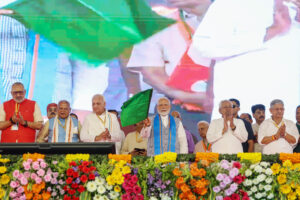
Prime Minister Modi unveils projects valued at ₹10 trillion at the Uttar Pradesh Global Investors’ Summit.

TheIndiaSaga Team |

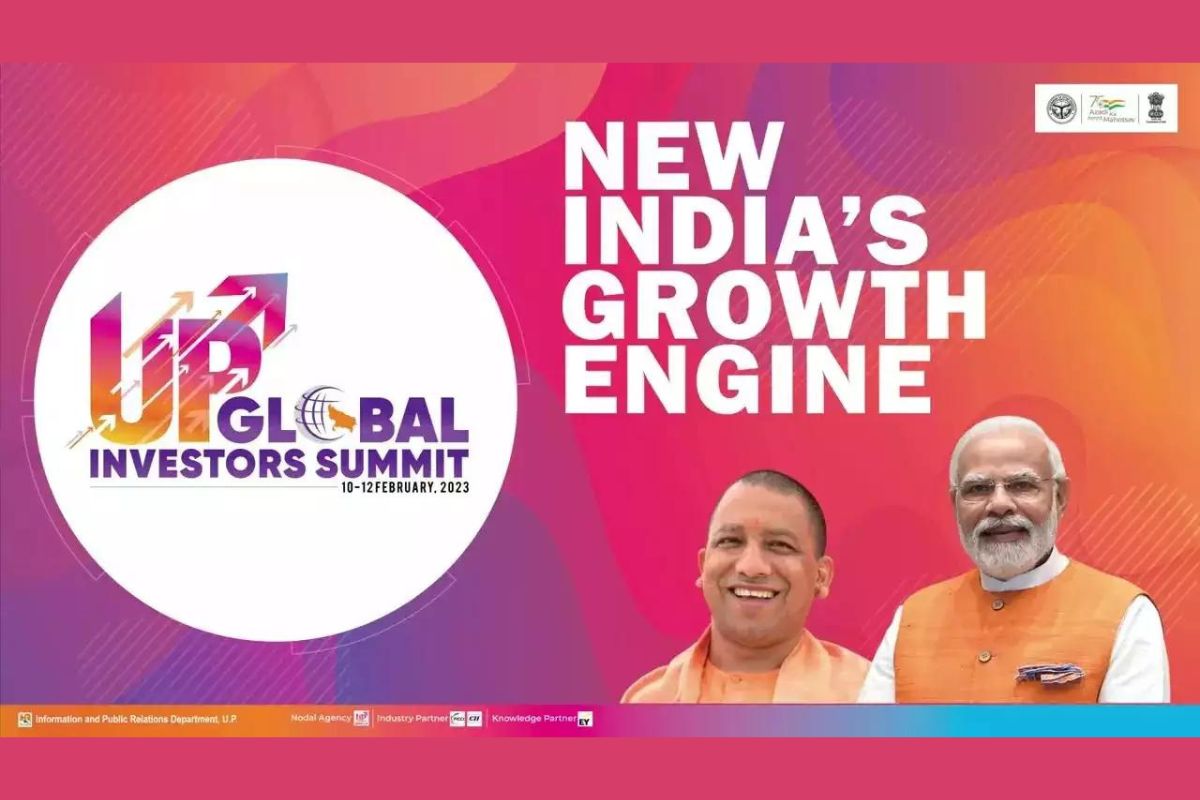
New Delhi: In Uttar Pradesh, Prime Minister Narendra Modi unveiled 14,000 projects on Monday worth over ₹10 trillion. Manufacturing, renewable energy, IT & ITeS, food processing, real estate, housing, hospitality, entertainment, and education are just a few of the industries this project touches on.

Uttar Pradesh Global Investors’ Summit: Modi presented a vision of progress during his speech in Lucknow, stating that this initiative aims to change the state’s landscape and represents a significant step towards creating a prosperous Uttar Pradesh as a foundation for Viksit Bharat, or a developed India.

Modi emphasised the increasing attraction of Varanasi and Ayodhya as top tourist destinations that draw many visitors, highlighting Uttar Pradesh’s potential as a tourism powerhouse. The prime minister claims that the state’s hospitality industry, airlines, and local business owners will all benefit significantly from this spike in tourism.

Along with highlighting Uttar Pradesh’s improved local, national, and international connectivity, PM Modi also announced the launch of the most extended river cruise in the world, which departs from Varanasi. According to him, the Kumbh Mela in 2025 will be a historic occasion to strengthen the state’s economy and create many jobs in the tourism and hospitality sectors.

Speaking to business owners in the food processing industry, Modi promoted the idea of “zero effect, zero defect” and urged everyone to work together to get Indian food products on tables worldwide. He emphasised the growing interest in millet as a superfood, encouraged investment in this area, and promoted collaborations between businesspeople and farmers. He emphasised the assistance provided to small-scale farmers by cooperative societies and Farmer Producer Organizations (FPOs), presenting a picture of the future in which business expansion and agricultural progress coexist.

At Uttar Pradesh Global Investors Summit, the prime minister informed the crowd, “Benefit to farmers and agriculture is good for your business too.”In his reflections, PM Modi emphasised Uttar Pradesh’s vital role in India’s rural and agricultural economy and urged all parties to take advantage of the current opportunities. Speaking with assurance for the people of the state and the combined efforts of the “double-engine government,” he saw a basis for broad advancement. Open up a world of advantages! Everything you need is right here, only a click away, including insightful newsletters, real-time stock tracking, breaking news, and a personalised newsfeed.

Russia-Ukraine War – Will India act as a mediator?

TheIndiaSaga Team |

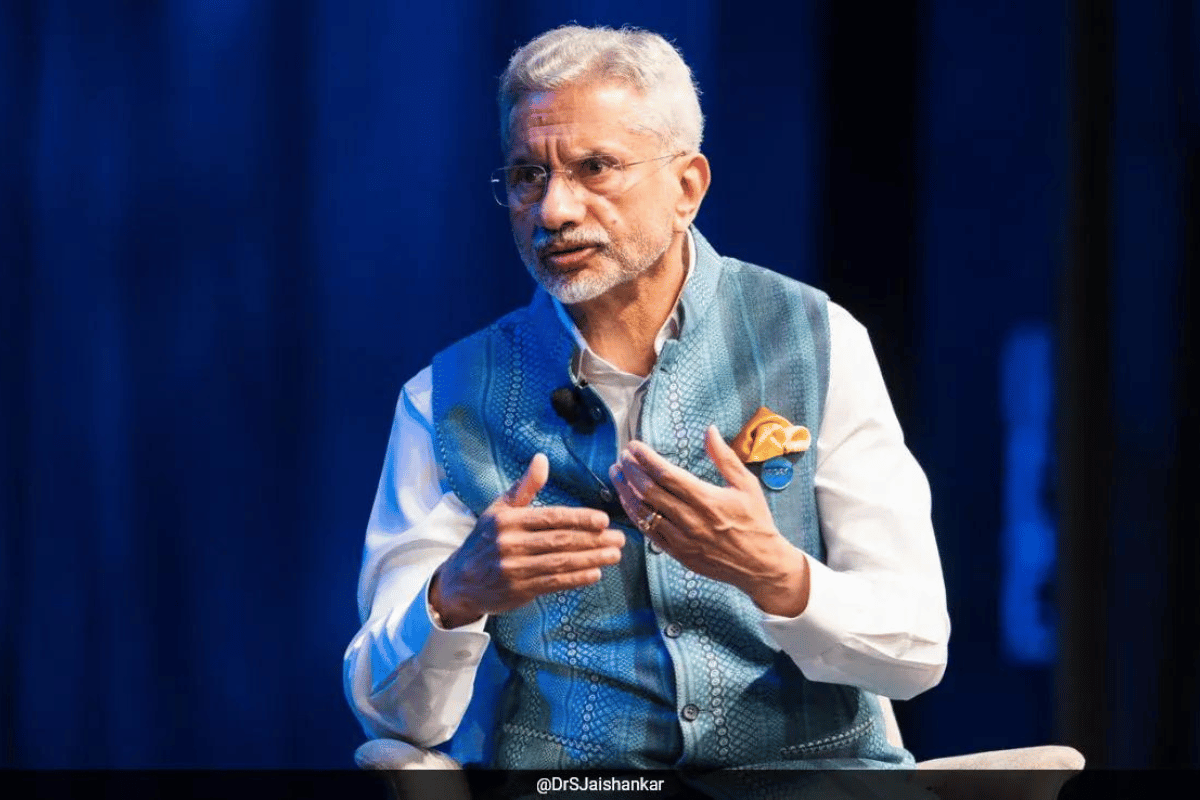
Russia-Ukraine War: S Jaishankar, the minister of external affairs, stated that while New Delhi does not think it should take the lead, it is willing to mediate to end the conflict between Russia and Ukraine if asked. In an interview with the German financial daily Handelsblatt, Jaishankar stated that after Russia invaded Ukraine in February 2022, India’s Middle Eastern energy suppliers prioritised supplying petroleum products to Europe at a premium.

India on Russia-Ukraine War

“When the fighting started in Ukraine, Europe shifted a large part of its energy procurement to the Middle East -until then the main supplier for India and other countries,” Jaishankar explained.

How ought we to have responded? Since Europe paid higher prices, our Middle Eastern suppliers frequently preferred that region. Since everything would have gone to them, we wouldn’t have had any energy. Alternatively, we would have paid significantly more due to your higher payment,” he continued. We stabilised the energy market in a sense that way,” he added.

When questioned about criticism from Europe levelled at India—that the country’s purchases of Russian crude oil undermine the Western sanctions imposed on Moscow for its invasion of Ukraine—he gave this response. The External Affairs Minister argued that Europe should realise that India cannot have the same perspective on Russia as Europe does, just as India did not expect Europe to maintain a stance on China similar to New Delhi’s.

Jaishankar stated that despite Moscow’s military aggression in Ukraine, India increased its economic ties with Russia. He added that the two countries’ relations are still “stable and friendly”, and Russia has never infringed upon India’s interests. Russia has never harmed our interests, based on India’s post-independence history. He said there have been ups and downs in the relationships between Russia and the US, Europe, China, and Japan.

“The current relationship with Moscow is based on a stable and always amicable relationship with Russia,” he stated. “We, on the other hand, had a politically and militarily much more difficult relationship with China, for example,” he added.

As stated by Jaishankar, India is “deeply convinced and committed to bringing the war in Ukraine to an end”. “The conflict is hurting everyone. We’re not far enough along in the process to know exactly how it will end, so I’m not sure,” he remarked. Regarding Russia’s military intervention in Ukraine, Jaishankar stated that India and Russia continue to cooperate militarily “because many Western countries have long preferred to supply Pakistan and not India.”

Akaay: Anushka Sharma and Virat Kohli were blessed with a baby boy

TheIndiaSaga Team |

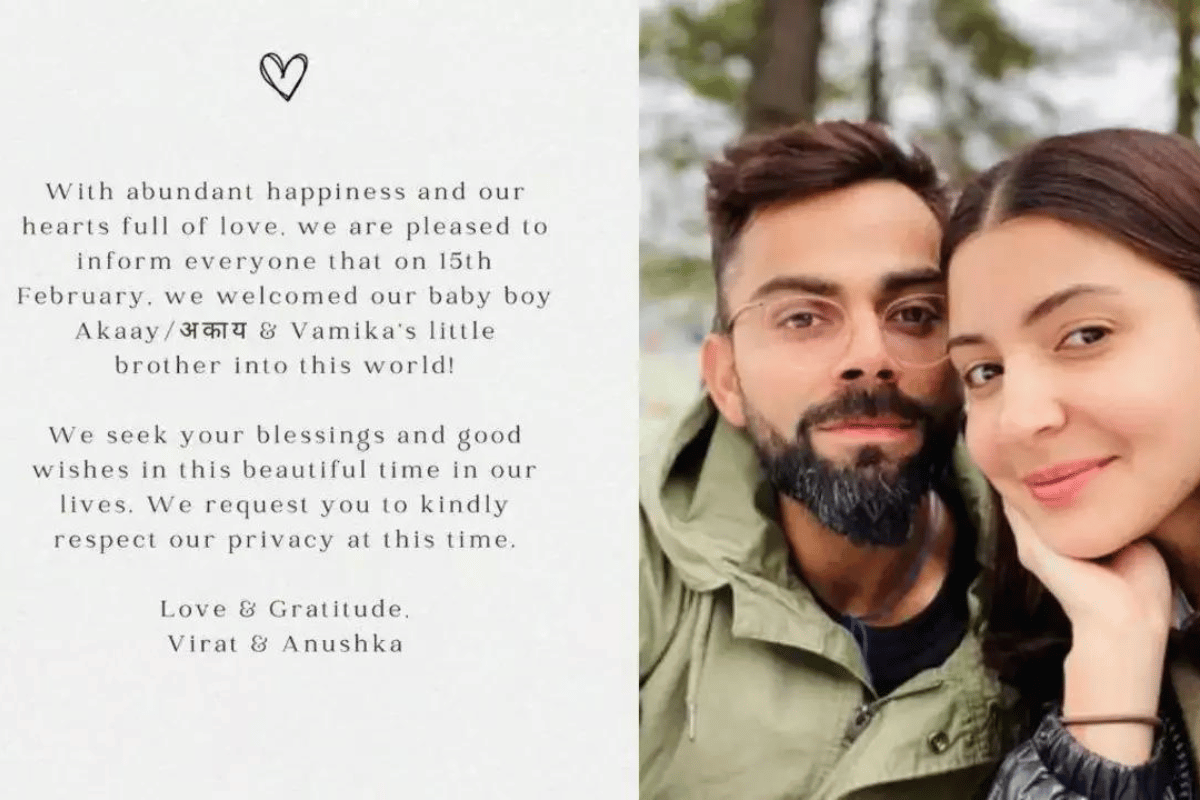
Anushka Sharma, a Bollywood actress, announced the birth of her second child on her Instagram page. On February 15th, the actor and former Indian captain Virat Kohli welcomed a baby boy. The child has been named ‘Akaay’ by the couple. Anushka announced the birth of her son with a note posted to her Instagram profile. The couple still needs to show their kid the picture, though.

Anushka wrote a lengthy note that said, “We are happy to announce to everyone that we have welcomed our baby boy, Akaay & Vamika’s little brother, into the world. We are filled with love and abundance.” In this lovely season, we ask for your blessings and best wishes. We respectfully ask that you respect our privacy. Virat and Anushka, with love and gratitude.” 

Notably, in contrast to their first pregnancy, the couple kept everything a secret. Anushka and Virat revealed their pregnancy during Vamika’s turn, and the actor also shared photos of herself with the growing baby bulge. On the other hand, Anushka stayed quiet and posted nothing on social media while she was expecting her second child. The actor didn’t make a lot of public appearances either. 

However, Virat Kohli withdrew from the current five-match Test series between England and India. The three remaining games were scheduled for the star cricket player, but Kohli did not make the squad. Notably, AB de Villiers, a close friend of Kohli’s and a former player for RCB, had also confirmed the news. However, he later claimed that was untrue. The internet was ablaze with news of Anushka’s second pregnancy, but the couple remained silent until today. 

Furthermore, it’s been reported that the Rab Ne Bana Di Jodi actor might have given birth to her second child in London rather than India. Fans of Anushka have received more than just good news from their social media post. However, supporters of Kohli now have explanations for his absence from the Test series. 

What does this unique name ‘Akaay’ mean?

The Sanskrit word akaay, which means “body-less” or “Nirakaar,” has many cultural connotations, including a shining moon in Turkish.

The name Akaay means “immortal” or “something that doesn’t decay” in Sanskrit.

In December 2017, Anushka and Virat, who are adored by their fans as “Virushka,” tied the knot in Italy. Vamika, Anushka and Virat’s daughter, was welcomed into the world in 2021.

The Story of Hanuman Ji’s Panchmukhi Avatar

sachin |

Ramayana is an Indian epic with so many stories of sacrifice, penance, dedication and love that we can learn from and bring changes to our lives. Hanuman Ji is a character in the epic who taught us the true meaning of unconditional love & worship. This write-up is the story of Hanuman Ji’s most deadly avatar, “Panchmukhi,” and how he saved Ram & Lakshman from Patal Lok’s strongest demon.

After Ravan sensed he might lose the Lanka war to Shri Ram, he became desperate to win. He planned a secret attack on Ram. He asked the ruler of Patal Lok  (Hell), his brother, to kidnap Ram & Lakshman and kill them. In anger, Hanuman Ji went to Patal Lok in his most deadly avatar. 

Mahiravan, also known as Ahiravan in some texts, was a sorcerer and the ruler of Hell. He was a brother of Ravana, the demon king of Lanka, who sought his help to defeat Rama and Lakshman in the epic battle of Ramayana. Mahiravan was well-versed in magical arts and possessed powers that made him a formidable foe, including the ability to become invisible and change form at will. 

As the war between Rama and Ravana raged on, Ravana, desperate to turn the tide in his favour, sought Mahiravan’s help. Mahiravan, in his loyalty to his brother, devised a plan to kidnap Rama and Lakshman and sacrifice them to the goddess Kali to gain invincibility.

Using his magical powers, Mahiravan managed to enter the camp where Rama and Lakshman were resting and kidnapped them using his sorcery. He transported them to Patal Lok, intending to perform a ritual sacrifice. The sudden disappearance of Rama and Lakshman caused great distress among their allies.

Upon learning of the abduction of Rama and Lakshman, Hanuman ji was filled with rage and concern for their safety. His devotion to Rama was unparalleled, and the thought of them being in danger ignited his fierce determination to bring them back at any cost. Hanuman’s immediate response was to set out on a rescue mission, utilising his divine powers to track down Mahiravana and infiltrate Patal Lok. In this netherworld (Hell), Mahiravan had taken Rama and Lakshman.

Mahiravan, a master of dark arts and sorcery, had received a powerful boon that made him nearly invincible. This boon made him invisible at will, making it exceedingly difficult for anyone to track or fight him. Mahiravan, endowed with a boon that made him nearly invincible, had kidnapped Lord Rama and Lakshman to sacrifice them to Goddess Kali.

Mahiravan could only be killed when five lamps, representing his life force and placed in five different directions, were extinguished simultaneously. This condition made defeating Mahiravan a daunting task. This task was seemingly impossible for any ordinary being due to the strategic placement of the lamps.

Understanding the gravity of the situation and the unique challenge posed by Mahiravan’s boon, Hanuman Ji devised a plan to tackle the sorcerer’s defences. His deep knowledge of divine powers and his ingenuity played a crucial role in formulating a strategy to defeat Mahiravan.

Looking at the entire situation, Hanuman Ji acted in his prowess. He took his deadliest avatar, PANCHMUKHI, a Five-faced avatar—A divine manifestation with five faces, each representing a distinct deity and direction:

Hanuman Ji’s Panchmukhi Avatar

  • Hanuman (East) – His original face, embodying devotion, strength, and protection.
  • Narasimha (South) – The lion-man avatar of Lord Vishnu, symbolising fierce courage and the ability to overcome obstacles.
  • Garuda (West) – The mighty eagle, representing speed and the power to counteract hostile forces.
  • Varaha (North) – The boar avatar of Lord Vishnu, denoting resilience and the capacity to uplift.
  • Hayagriva (Upwards) – The horse-faced avatar associated with wisdom and knowledge.

Armed with his Panchmukhi form, Hanuman Ji descended into Patal Lok, ready to confront Mahiravana and his dark forces. The battle that ensued was monumental, showcasing Hanuman’s unparalleled might and the strategic genius of his Panchmukhi avatar. With each face wielding distinct powers, Hanuman could counter Mahiravan’s sorcery, combat his minions, and keep the lamps in sight.

With the lamps extinguished, Mahiravan’s boon was nullified, rendering him vulnerable. Hanuman seized this opportunity to engage Mahiravana in direct combat. The battle was fierce, but Hanuman’s divine strength, coupled with the strategic advantage of his Panchmukhi form, ultimately led to Mahiravan’s defeat.

With Mahiravan vanquished, Hanuman Ji quickly located the captive Lord Rama and Lakshman. Using his immense strength and divine powers, Hanuman liberated them from their confines and escorted them safely out of Patal Lok. The return journey was swift, with Hanuman ensuring their safety and comfort. They returned with the spirit as the great Lanka war awaited their final duel. 

This is only one incident of unconditional love and sacrifice that shows the greatness of Indian history. The history of Bharat is very rich and filled with so many courageous incidents from which we can learn and transform our lives. This is the responsibility of every Indian as a proud citizen of the country that we never forget these amazing sacrifices. 

5 interesting facts about Chhatrapati Shivaji Maharaj

TheIndiaSaga Team | Updated :

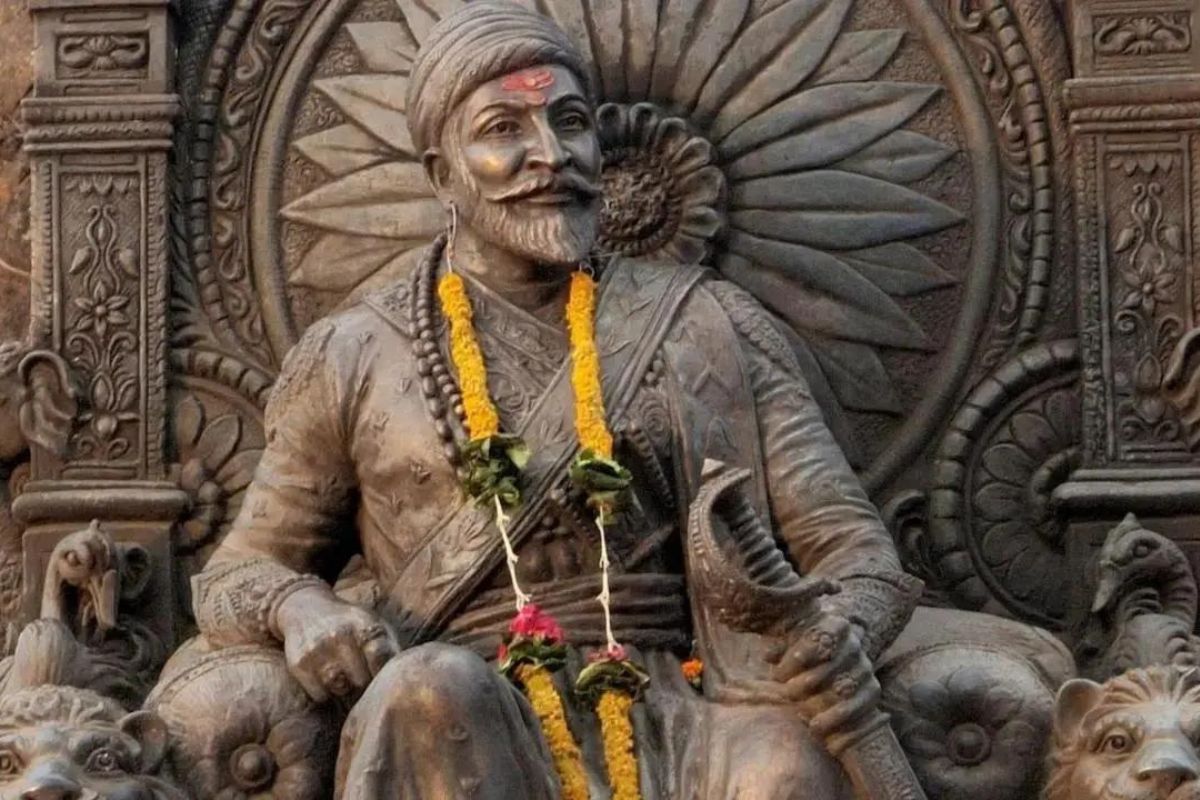
Every year, India celebrates 19 February as Chhatrapati Shivaji Maharaj Jayanti; he was an Indian ruler from the Bhonsle-Maratha dynasty. He, also known as Shivaji or Shivaji Raje Bhosale, was born to Shahaji Bhosale and Jijabai on 19 February 1630 in Shivneri Durg, Pune.

During the regime of Muslim invaders, Shivaji was among the native Indian leaders who fought for the unity and integrity of India. He was the first to give the idea of Hindavi Swaraj and aroused feelings of nationalism; the freedom fighters in India’s freedom struggle also adopted the strategy.

One of his most famous sayings still encourages the countrymen, “Even if there were a sword in the hands of everyone, it is willpower that establishes a government.”

PM Modi also shares greetings on X (formerly known as Twitter), “Greetings to Chhatrapati Shivaji Maharaj on his birth anniversary. Visionary leaders, fearless warriors, custodians of culture and epitome of good governance, his life has inspired generations.”

How YouTube and Instagram crushed Indian Short Video Apps?

On his 394th birth anniversary, let’s explore some 5 interesting facts about Shivaji Maharaj.

Father of Guerrilla Warfare: Shivaji Maharaj is also known as the father of guerrilla warfare, showing he had deep insights into geography and was very well aware of how to use it during battle. Aware of the fact, his rivals called him a ‘mountain rat.’ 

Proposer of Hindavi Swaraj: It was a call for self-governance, highlighting the essence of democracy—in the war of independence, leaders like Bal Gangadhar Tilak and MK Gandhi adopted the concept. 

Great Supporter of Women: He always stood for the respect and honour of women; he never harassed women during raids and was totally against the violence against women. Under his regime, women from captured territories were never taken as prisoners. The one who tried to harass women was punished severely.

Founder of the Indian Navy: In the early days of his leadership, Shivaji identified the importance of the Navy. He established a consolidated naval force to protect the Sealine from foreign invaders like the Dutch, Portuguese, British, and French. He also built naval forts such as Vijaydurg, Sindhudurg, and numerous other locations, and he commissioned four distinct types of warships, including Manjuhas, Pal, Gurabs, and Gallibats. Therefore, he is recognised as the father of the Indian Navy.

Goddess Shivai: The name of Shivaji Maharaj is derived from Goddess Shivai. 

The Axis Bank deal and the new RBI deadline cause Paytm shares to rise 5%

TheIndiaSaga Team |

On Monday, there was a 5% increase in the price of Indian payments company Paytm’s stock after the central bank of the nation gave its banking division more time to shut down, and the company teamed up with Axis Bank to try to maintain some of its well-liked products. The stock reached 358.35 rupees, the upper trading limit. On Friday, the Reserve Bank of India (RBI) gave Paytm Payments Bank until March 15 instead of February 29 to cease taking new deposits into its wallets or accounts.

According to Bernstein analysts, the deadline extension will allow for a “smooth transition” to transfer Paytm Payments Bank accounts. As part of its efforts to address the current crisis, Paytm signed up Axis Bank as a new banking partner on Friday to maintain some of its well-liked products.

Urbn Plugs In Kartik Aaryan as Brand Ambassador

Brokerage Citi noted that despite keeping its “Sell” rating and 550 rupee price target on the stock, the company will likely pursue more of these partnerships because it sees them as “significant positives for ongoing business.”

Bernstein called it a “huge plus” that merchants can use Paytm QR codes, soundboxes, and card machines if they are connected to bank accounts other than Paytm Payments. Since the RBI’s order against Paytm Payments Bank on January 31, brought about by what the central bank officials described as persistent non-compliance with regulations, Paytm shares have dropped 53%. The stock market meltdown has reduced shareholders’ wealth by 255.74 billion rupees ($3.08 billion).

Based on LSEG data, analysts generally assign a “Hold” rating to Paytm. For the first time in at least a year, there are five “Sell” or “Strong sell” recommendations for the stock. $1 is equal to 82.9880 Indian rupees. (Reporting from Bengaluru by Nandan Mandayam; editing from Rashmi Aich and Sonia Cheema).

Delhi Liquor Policy Case: Arvind Kejriwal skips ED summons for the 6th time in a row

Delhi Liquor Policy Case: Arvind Kejriwal skips ED summons for the 6th time in a row. Here is the full news about the case.

Arsh Verma |

Delhi Liquor Policy Case: Chief Minister of Delhi Arvind Kejriwal skips another summons by the Enforcement Directorate (ED) on Monday on the connection of the Delhi Liquor Policy Case, as per the sources of Aam Aadmi Party (AAP). The summons is illegal as the matter of the validity of the summons is now in the court, said the Aam Aadmi Party. The party further said the Enforcement Directorate itself presented the matter before the court, and rather than sending summons again and again, ED should wait for the court’s order, said the party sources.

Arvind Kejriwal, Delhi Chief Minister, would not appear before the Directorate of Enforcement (ED) for interrogation concerning an excise policy issue relating to money laundering, Aam Aadmi Party (AAP) officials said Monday.

Arvind Kejriwal, Delhi Chief Minister, would not appear before the Directorate of Enforcement (ED) for interrogation in connection with an excise policy issue relating to money laundering, Aam Aadmi Party (AAP) officials said Monday.

Farmers protest 2.0 calls for Bharat Bandh on 16th February

TheIndiaSaga Team |

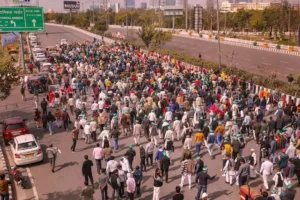
In the ongoing protest in North India, farmers have called for a Bharat Bandh on Friday, urging the people of this region to go on an industrial strike and shut down rural India. Two consecutive meetings between the Union Cabinet and farmer leaders have not been conclusive about why they have taken this step.

Holding the Indian government responsible for the start of Farmers Movement 2.0, the farmers said that the Modi government has not fulfilled their demands. In fact, in 2020, the government passed three new laws related to agriculture, which they demanded to withdraw, calling them black laws. However, when the government did not do this, the farmers surrounded Delhi from all sides in September 2020; this protest ended in November 2021, when the Prime Minister withdrew these laws and requested the farmers to end the protest. While completing the protest, the farmer leaders had made some demands from the government, among which the law on MSP was the most important.

Farmers started protests demanding MSP from the Union government in Delhi

What is the demand of farmers?

  • According to the Swaminathan report, the government should make a permanent law on MSP for all crops according to the A2+FL+C2 formula.
  • The government should forgive all the farmers in the country and all their debts.
  • Farmers above 60 years of age should be given a pension of Rs 10,000 per month so that they can secure their future.
  • Restore the Land Acquisition Act 2013 at the national level, require written consent from farmers and provide compensation four times the collector rate.
  • The government of India must ensure a legal punishment for the culprits who were responsible for the farmer’s death in Lakhimpur Kheri, and the families of the farmers should get justice.
  • India should exit the World Trade Organization and stop all free trade agreements to protect domestic agriculture.
  • The government should compensate the families of the farmers who lost their lives during the Delhi agitation and also provide employment opportunities to one member of their family.
  • To protect their interest and ensure equal access to electricity, the government should reject the Electricity Amendment Bill 2020.
  • Extend the Mahatma Gandhi National Rural Employment Guarantee Act (MGNREGA) to provide 200 days of employment annually with a daily wage of Rs 700 and integrate it with agricultural activities.
  • Enforce stringent penalties on companies producing spurious seeds, pesticides and fertilisers while improving seed quality standards.
  • Establish a national commission dedicated to supporting and promoting the cultivation of spices such as chilli, turmeric and other aromatic crops.

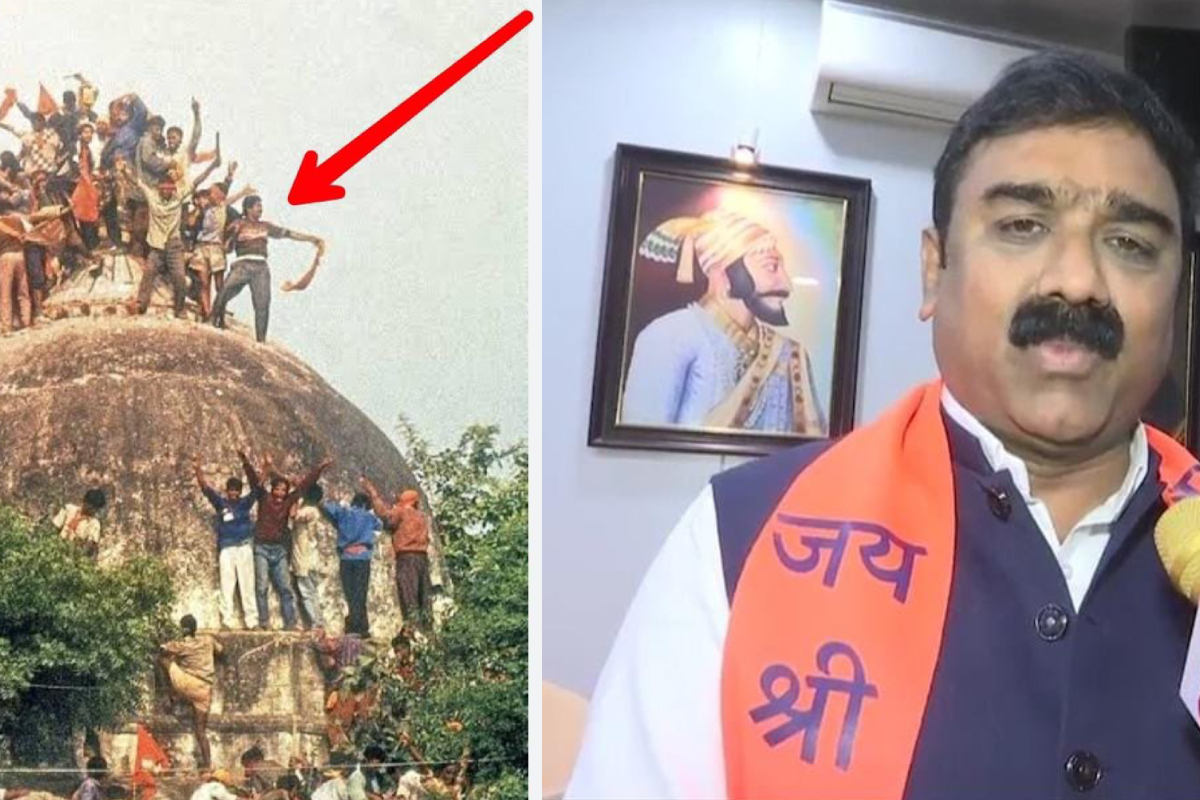
Ajeet Gopchade: BJP Nominates Karsevak from Maharashtra

As BJP nominated Ajeet Gopchade for the Rajya Sabha, his old photo went viral where he can be seen atop the Babri Masjid during the Ram Janmabhoomi moment in December 1992. 

Arsh Verma |

Ahead of the upcoming Rajya Sabha polls, the Bhartiya Janta Party (BJP) nominated candidates from Maharashtra, including former CM Ashok Chavan and former Kothrud MLA Medha Kulkarni. Ajeet, whose photo is now viral all around social media, was there in Kar Seva during the Babri Masjid demolition in December 1992. Ajeet Gopchade participated in the Kar Seva in Ayodhya. The event, which is known as the Ram Janmabhoomi moment, took place in Ayodhya Nagri to demolish the unfairly and forcefully built Babri Masjid by the Mughals.

Ajeet Gopchade was pictured with an army of Karsevaks standing atop the Babri Masjid, a photograph that eventually became a symbol of the event. Following his nomination to the Rajya Sabha, identical photographs of Gopchade have resurfaced on social media.

Who is Dr. Ajeet Gopchade

Dr. Ajeet Gopchade has been a dedicated Rashtriya Swayamsevak Sangh (RSS) worker who is well-known for his unwavering commitment to the organisation. He had been given the role of Maharashtra BJP’s vice-president. His name is commonly mentioned in connection with Nanded’s Lok Sabha seat and the Nanded and Naigaon assembly constituencies. He is noted as being proactive in social and educational pursuits.

Educational Background

While in college, he took the lead in organizing several student movements. He served with the BJP’s student wing ABVP alongside BJP stalwarts such as Pramod Mahajan, Gopinath Munde, and Nitin Gadkari. His contributions to health and medicine are also notable. Dr. Ajeet Gopchade specializes in pediatric disorders and holds MBBS and MD degrees.

Electoral Bonds Downfall: SC Declares Scheme Unconstitutional

TheIndiaSaga Team |

On Wednesday, February 15, the SC gave a historic verdict and rejected the recognition of Electoral Bonds, declaring them unconstitutional. A bench of 5 judges led by Chief Justice of India DY Chandrachud gave this decision. There has been a long-standing demand from opposition parties to quash these. A five-judge Constitution bench headed by the Chief Justice of India highlighted that “a voter must effectively exercise his freedom to vote. “Requires information about the financing a political party receives”.

CJI DY Chandrachud said that the changes made in the laws to implement the scheme are unconstitutional. Holding the scheme to be a “violation” of the constitutional right to freedom of speech and expression and right to information, the court did not agree with the Centre’s contention that it aimed to bring transparency and curb black money in political funding.

What are Electoral Bonds?

Electoral Bonds are promissory notes that any Indian citizen and company can buy from some State Bank of India branches. A citizen or a private company can donate these bonds to his favourite political party.

When and who started these bonds?

The NDA coalition government introduced it in 2018, along with the Finance Bill 2017 and implemented them on January 29, the same year.

What was its motive, and how did these electoral bonds benefit political parties?

The government cited the reason behind implementing this: it can bring transparency to political funding. The government used to withdraw money from the bank by selling the bonds purchased by an Indian citizen or company in the party’s name, which they benefited from during elections. The bank also had rules in this process, such as only those whose accounts were KYC verified could buy bonds from the bank, and the bank leaders could give information about those buying the bonds at any time.

Did bond buyers get any benefit from it?

Investors who invested in electoral bonds have yet to get any official returns. This bond was similar to a receipt. The bonds were purchased in the name of the party you wanted to donate to, and the money was provided to the concerned political party.

Do those who buy electoral bonds get tax exemption?

There is a provision to give exemption under sections 80GGC and 80GGB of income tax on the amount donated through electoral bonds instead of donating directly to the political party.