Logo

Logo

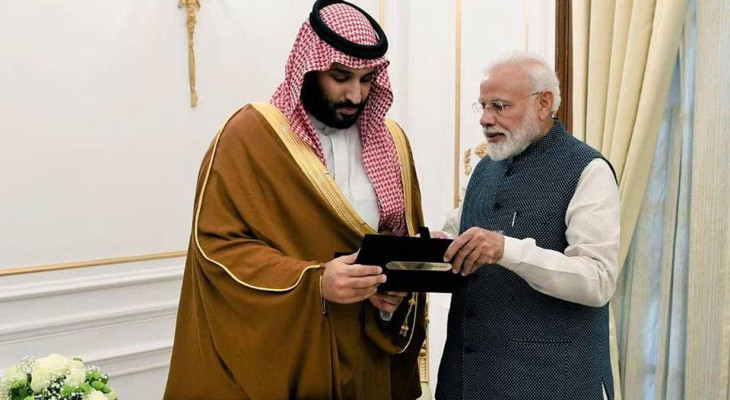
Prime Minister Modi & Saudi Crown Prince Salman’s Strategic Partnership Talks to Happen in Delhi

Preyensha Srivastava |

Prime Minister Narendra Modi and Saudi Arabia’s Crown Prince Mohammed bin Salman Al Saud are set to engage in discussions today, covering a wide array of topics during the Crown Prince’s State visit. This visit follows his arrival in Delhi as part of a three-day tour that commenced with the G20 Summit in the national capital of India.


The Crown Prince of Saudi Arabia is scheduled to receive a formal reception at Rashtrapati Bhavan at 10 am, preceding his meeting with PM Modi at 11 am. Following his interactions with PM Modi and other esteemed individuals, Prince Salman will have a meeting with President Droupadi Murmu at Rashtrapati Bhavan at 6:30 PM, before his departure from New Delhi at 8:30 PM. This marks Prince Salman’s second official visit to India. 


What’s on the agenda? 


The focal point of their meeting, hosted at Delhi’s Hyderabad House, will be the First Leaders’ Meeting of the Strategic Partnership Council. This council stems from a bilateral agreement inked by India and Saudi Arabia in Riyadh back in 2019. The agenda includes a comprehensive review of the progress made by the ministerial committees operating under the Strategic Partnership Council. 


These committees encompass areas such as Political, Security, Social, and Cultural Cooperation, as well as economic and investment cooperation. Additionally, the leaders plan to delve into a broad spectrum of bilateral relations, spanning politics, security, defence, trade, economy, culture, and people-to-people connections. Furthermore, the discussions will extend to regional and international matters of shared concern, as outlined in an official government release.


The two nation’s history 


India and Saudi Arabia both share a long history of cordial and cooperative relations along with extensive people-to-people ties. In the fiscal year 2022-2023, the bilateral trade between both countries reached an all-time high of USD 52.75 billion as per the data by the government. 


During his 2019 visit to Riyadh, PM Modi stated that India and Saudi Arabia have a Joint Committee on Defence Cooperation (JCDC) that conducts meetings regularly and also that the two nations have identified a plethora of areas of mutual interest and cooperation in the field of defence and security. 


India and Saudi Arabia, both economic powerhouses, share a robust trade relationship. Saudi Arabia ranks as India’s fourth-largest trading partner, while India holds the position of being Saudi Arabia’s second-largest. These nations also maintain a substantial partnership within the energy sector, as India heavily relies on importing substantial quantities of oil from Saudi Arabia.


The road ahead 


During the two-day G20 Summit held in New Delhi, Saudi Arabia was among the signatories to the ambitious India-Middle East-Europe Economic Corridor. The initiative, often viewed as a potential substitute for China’s Belt and Road Initiative, was collaboratively unveiled by Prime Minister Modi and the leaders of the United States, Saudi Arabia, the United Arab Emirates, France, Germany, Italy, and the European Union during the G20 summit. Upon its realisation, this endeavour has the potential to act as a contemporary version of the Silk Road, which historically played a pivotal role in fostering economic collaborations, political alliances, and cultural exchanges spanning continents.

G20 Presidency shows the world how India’s century has arrived

Arsh Verma |

India bids adieu to the historical 18th summit of G20 members on Sunday, resulting in successful bilateral meetings with the Global Leaders and the Chiefs of International organisations. The biggest takeaway from the summit is the inclusion of the African Union as a permanent member in the group. The group also produced a consensus document on the Russia-Ukraine conflict. The bloc criticised the actions, saying that no nation can harm the people and grab others’ territory forcefully but no one in the meeting directly condemned Russia for its actions. State representatives of America, India, and Saudi Arabia are planning to counter the border road initiative of China by setting up ports and rail links between the Middle East and South Asia.


On day one, the 55-member African Union officially became a permanent member of the G20 at the level of the European Union to make the group more representative. Until now, South Africa was the only nation from the African Continent to be a part of the G20 group. Joining the African Union would give the Global South more power in the G20 bloc, whereas the G7 countries have long played a dominant role. The move also comes after the BRICS, another grouping dominated by China and Russia, was expanded to include Saudi Arabia and Iran, which was seen as an attempt by Beijing to make it a possible alternative to the G20.


G20 leaders aiming to triple renewable energy capacity globally by 2030 agreed on the need to phase out inexhaustible Coal power but stopped setting big climate targets. The group did not present a plan to change existing policies and targets to achieve the goal of increasing the use of renewable energy sources. It also said it would cost $4 trillion a year to pay for the transition to green energy, but offered no option. The G20 negotiations have been closely watched ahead of this year’s COP28 climate summit in the United Arab Emirates. 


Indian Prime Minister Narendra Modi presided over the G20 as a year-long opportunity to present India as an influential, diplomatic, and economic power. This indicates that the world’s most populous nation is ready for direct investment and trade flows. It also gave PM Modi a platform to improve his standing at home as he seeks a third term in elections in the coming months. Modi’s image was on G20 billboards across the capital and in the huge and elegant new conference venue. To his supporters, the successful outcome of the summit signalled that India’s great moment had arrived.


Jaishankar, Minister of External Affairs, highlighted that India’s presidency shows the world that Bharat is ready to shape global ideas and issues. Senior Congress leader and MP Sashi Tharoor praised the Government of India by saying, “G20 Summit is an achievement for Indian diplomacy.” He also praised Amitabh Kant, an Indian bureaucrat and G20 Sherpa for its efforts.

Jawan: Shah Rukh Khan comes back with a banger at the Box Office

Preyensha Srivastava |

The Badshah of Bollywood, Shah Rukh Khan’s second movie of the year, just got released. It received a warm welcome from the viewers as the film made INR 75 crore in all languages on the first day itself. The movie also surpassed Gadar 2 and Jailer’s first-day collections. The movie’s storyline revolves around a man who is on a personal mission to fight against all the evils of society because he made a promise years ago. Therefore, he goes on to fight a dangerous lawbreaker who has bothered many people.


Jawan Fan Reviews


The superstar made his comeback in January with Pathaan, and now he has delivered a blockbuster yet again. The critics, cinephiles, and fans have liked the movie and called it a hit. The film got a massive positive response from the people. Shah Rukh Khan proved his dominance not only in the Indian film market but around the globe. According to a film trade analyst, the movie made its mark in Australia and New Zealand by debuting in the first spot collecting Rs.2.11 crore and Rs.39 lakhs respectively. In Germany, it came in at third spot with an opening day collection of Rs.1.3 crore.


Competition with Gadar 2 


Gadar 2 was launched on August 11 and got off to a great start, earning a staggering 40.1 crores on its first day. The film’s popularity persisted on its second day as well, earning 43.08 crores, an increase of 7.43 per cent from its first. After Jawan’s release, the movie still made 1.50 crore on Day 28, bringing its overall revenue in India to 510.59 core, according to a report from a film trade analyst website. The original cast members Sunny Deol, Ameesha Patel, and Utkarsh Sharma returned to play Tara Singh, Sakeena, and Charanjeet Singh, respectively, in Gadar 2, which was directed by Anil Sharma. Gaurav Chopra, Manish Wadhwa, Manoj Bakshi, Simrat Kaur, Luv Sinha, Rohit Chaudhary, and Rakesh Bedi also appeared in the movie. 


Jailer vs Jawan 


Jailer which debuted in theaters on August 10 had an electrifying Day 1 haul of 48.35 crores. The Tamil version brought in 37.6 crores, the Telugu version added 10.2 crores, and the small Kannada version brought in 0.2 crores. The movie brought in 0.35 crore in the Hindi region. According to the data, the movie made a total of 398.68 crore in net revenue in India and a total of $593 crore internationally. Rajinikanth’s Jailer also had its digital debut on Prime Video on the day of Jawan’s release in theaters. 

Jawan may come out to be one of the biggest movies of 2023, With Shah Rukh Khan’s acting, along with Nayantara’s elegance and screen presence the movie gets an edge over its competitors. SRK’s double role, the movie’s script, and the action in the movie are the key features that will force the public to praise the masterpiece. 

Celebrity MUA and hairstylist Parul Mehta sets new beauty trends with innovative makeovers

sachin |

In the realm where beauty becomes art, celebrity MUA and Hairstylist Parul Mehta is a visionary trendsetter, redefining glamour with her unparalleled creativity and transformative touch. With each brushstroke and strand she delicately shapes, Parul Mehta has become a beacon of innovation, setting new beauty trends that resonate across runways, red carpets, and social media feeds.


Parul’s journey into the world of beauty and hair started as a passionate endeavor. She was in 8th grade when she started her journey as a mehendi artist, and now, over the years, her passion has blossomed into an inspiring career that continues to make waves. Her ability to seamlessly blend classic styles with cutting-edge techniques has earned her a devoted following among both celebrities and beauty enthusiasts.


What sets Parul apart is her fearless embrace of innovation. She has always believed in being experimental and trying new looks. She doesn’t merely follow trends; she shapes them. She has a meticulous eye for detail and thus focuses on every step, from applying the primer to sparing the makeup fixer and every step in between.


From avant-garde editorial shoots to elegant bridal transformations, Parul’s portfolio is a testament to her versatility. It’s not just about makeup and hairstyles. Her makeovers have always sparked an ooze of enthusiasm and self-confidence in her clients.


Parul has worked with other celebrities like Kinjal Dave, Khushi Shah, Salon Mittal, Sukhman Gambhir, Neha Jethwani, Prachi Solanki, Gurleen Gambhir Khakhar, Riya Jain, Pankhudi Kunal Pandya, and the list goes on. She is a certified beautician and the founder of Paruls Beauty Care. Her work can be seen on her official Instagram account, @paruls_bride, and her makeup looks are loved by netizens. Not only that, but many of her bridal makeup looks have made it to the top wedding media’s Instagram pages.


She is an inspiration to all who aspire to redefine beauty on their terms. In a world where trends come and go, Parul Mehta’s influence continues to shine, setting new beauty standards and inspiring others to embrace their own unique beauty journey

G20 Summit: The IAF comes in action ahead of the event

Preyensha Srivastava |

The Indian Air Force (IAF) has planned out a detailed strategy to protect Delhi’s skies at the time of the G20 Summit on September 9-10, with a number of assets put in place to defend the national capital from a wide scope of potential threats. “A number of arms and ammunitions are deployed including a range of fighter jets, different types of surface-to-air missile systems, and airborne surveillance platforms to anti-drone systems, The Air Force will be on high alert and will look to detect, track, and neutralize any airborne threat, over the weekend,” said one of the officials of security.


Another official of security reported, “IAF’s air security cover has taken the position to safeguard the capital against a wide range of hazards including drones, gliders, smaller aircraft, missiles, and even fighter planes.” IAF has the capability to locate and hunt down dangers at a distance of up to hundreds of kilometers and execute the steps required to balance them. IAF’s Operations Direction Centre (ODC) and the Joint Command and Analysis Centre (JCAC) operations center at IGI Airport will have the key responsibility of guarding the skies ahead of such a major event in which the heads of state including US President Joe Biden and UK Prime Minister Rishi Sunak will participate.


“After a threat is detected, ODC will employ the right platform to counter it,” said the first official. “Some fighter jets at airbases near Delhi, including the ones in Punjab and Haryana, will be ‘operational readiness platform’. The main purpose of these platforms will be to get the jets to fly in the air in 5 to 7 minutes to react to any situation. IAF’s airborne prior alert and control aircraft and the indigenous airborne early warning and control (AEW&C) systems will be employed during the conference for surveillance, detection, and tracking of potential threats at spans of up to 400 km,” the officers added.


Air Marshal Anil Chopra (retd) said that whenever any high-profile meeting of the level of G20 takes place in a nation, the air defence needs to be intact as we can not allow any mishappening to occur. The steps like air defense systems positioning, airborne and ground-based radar coverage, anti-drone techniques, and keeping armed fighter jets on halt, will always be ready for actions. “These systems provide two options called  ‘soft kill’ and ‘hard kill’ to counter aerial dangers. The first refers to obstructing the enemy drone, while the second includes a laser-based kill approach.” The drone attack on an IAF command in Jammu two years ago is said to be the first-ever offensive use of drones to attack an Indian military center. It was a watershed in asymmetric combat and underlined the requirement for the army forces to learn capabilities to prevent, detect and neutralize such threats.


Also read: https://www.theindiasaga.com/nation/g20-2023-new-delhi-is-ready-to-host-the-historical-summit


Bollywood Actor Sharib Hashmi in Aneek Chaudhuri’s upcoming Hindi film on AI

sachin |

The shooting of the Hindi Film ‘The Zebras’ is all set to start soon. The movie revolves around the topic of Artificial Intelligence and its aftermath in the world of Fashion. The movie is a Hindi feature-length film that will be made under Aneek Chaudhuri’s direction. It will produced by Akhil Murali and Ashik Murali under Yulin Productions, Kerala. The film stars Bollywood actor Sharib Hashmi (The Family Man, Tarla, Filmistaan, Vikram Vedha), Bengali star Priyanka Sarkar and Usha Banerjee.


Aneek Chaudhuri, the film’s director is a filmmaker hailing from Bengal. He has been involved with films that were selected and screened at international film festivals of repute. Besides, the script of his recent film ‘Jharokh’ has been selected by the OSCARS for inclusion in its library.


Sharib Hashmi was last seen in Tarla (on Zee5), Afwaah (on Netflix), and Shiv Shastri Balboa. The director Aneek says, “It is a dream come true moment being able to direct such a good actor like Sharib. Sharib Bhai has been extremely supportive throughout the process and it is always a treat working with him. Really looking forward to it.”


Priyanka Sarkar was last seen in Abar Bibaho Obhijaan and Manobjomin. On Priyanka, Aneek says, “She is one of those rare actors from Bengal (currently) who exhibits both, the eagerness to break down and a landscape of emotions. She always was my first choice for this kind of a role, where she is portraying a model’s character.”


Aneek has earlier worked with Usha. On their third film together, he adds, “She has been a good support; and the one I go up to for my films. Usha has always been subtle and this time, she has been involved with the film since we began this journey.”


The director adds, “I am extremely thankful to Yulin Productions and Akhil-Ashik for coming forward in this endeavour; besides, I am grateful to Praveen Menon ji (eminent production controller from Kerala) who had introduced me to them. The producers are extremely supportive and are involved in the creative process right from the beginning.”


Yulin Productions was last involved with the production of the Malayalam film ‘Digital Village’. The Zebras is their foray into Bollywood films. The project is scheduled to go on floors soon.

Top 10 Most Expensive Indian Movies

Preyensha Srivastava |

The Indian film industry is known for its grand, and glamorous films. It is one of the biggest film industries in the world that, with its grandeur, raises the budget of the films. High-budget films also attract large masses of crowds generating a ton of money. From RRR to Jawan, Thugs of Hindostan, and Adipurush, here are the most expensive films ever produced in India. 


Here is the list of Top 10 Most Expensive Indian Movies


1. Adipurush 


A movie based on Hindu mythology starring Prabhas and Kriti Senon was supposed to be a super hit. The movie was full of VFX and special effects and this was the main selling point of the film. The movie was made on a budget of Rs. 600 Crore.  However, the film faced a lot of backlash and hate from the audience.


2. RRR


The most hyped, Rs 600 crore banger, RRR is one of the best films ever produced. The movie was directed by SS Rajamouli and starred Junior NTR and Ram Charan. It was nominated for the Oscars and the movie won it for its song Natu Natu.


3. 2.0 


The movie featured two of the mega stars of the Indian film industry Rajnikanth and Akshay Kumar. The movie is a sequel to a sci-fi movie Robot. It was made on a budget of Rs.575 crore and released in 2018. The movie tries to give a good message to society. The story starts when mobile phones start to flee out of the hands of the residents of Chennai, Doctor Vaseegaran and his android assistant, Nila, are called to the recovery; together, they face the esoteric powers of Pakshi Rajan.


4. Ponniyin Selvan-1


PS-1 or Ponniyin Selvan is the most expensive movie ever made in India. It was directed by Mani Ratnam and was released in 2022. The grand shooting of the drama cost around Rs. 500 Crores. The movie stars Aishwarya Rai Bachchan, Vikram, Jayam Ravi, Karthi, Trisha,  Jayaram, Aishwarya Lekshmi, and others in crucial roles. The story of the film is based on a Tamil novel.

5. Pushpa: The Rise


Director Sukumar directed a masterpiece named Pushpa The Rise,  an action thriller. The film was made on a budget of Rs. 400 crores, making it an expensive movie. Allu Arjun and Rashmika Mandanna play important roles in the film. The film revolves around a  worker named Pushpa who makes rivals as he advances in the world of red sandalwood smuggling. However, brutality erupts when the police try to bring down his unlawful business.


6. Saaho


When a South Indian superstar features in a film, then it being a high-budget one is quite obvious. The movie Saaho is yet another action thriller, with Bahubali’s hero Prabhas and Shraddha Kapoor as the protagonists of the film. The film was made on a budget of 350 crores. The plot of the film is about a secret cop who goes on a task to capture a gang of thieves.


7. Thugs of Hindostan


The Multi-Starrer high-budget most anticipated film, Thugs of Hindostan was released in 2018. The expectations from the film were very high because it had Aamir Khan, Amitabh Bachan, and Katrin Kaif as the leads. Made on a budget of Rs.310 crore the story of the film revolves around Firangi, a thug, who is appointed by the East India Company, who advises him to penetrate their enemy, Azaad, and his group of thieves. Firangi is torn between saving and betraying the thieves.


8. Jawan


The 2023 action-packed thriller starring Shah Rukh Khan is one of the most expensive films made in Bollywood. The film, produced by Gauri Khan under the Red Chillies Studios, is estimated to have a budget of 300 crores as per reports. The film was released on September 7 in theatres in Hindi, Tamil, and Telugu languages. 


9. Radhe Shyaam 


Yet another Prabhas movie is on the list. Prabhas and Pooja Hegde starrer Radhe Shyaam was a romantic drama based in the 1960s. The anticipated budget for the movie was Rs 300 Crore.


10. Samrat Prithviraj 


A 300-crore historical movie, placed in the 12th Century, is a magnificent narration of the heroics of Samrat Prithviraj Chauhan, one of India’s most prominent emperors. He is known for his courage and sacrifices for the country and his undying love story with Princess Sanyogita. Samrat Prithviraj Chauhan also fought against the powerful Mohammed Ghori of Ghazni, humiliating his vicious plans of ruling India. The movie had Akshay Kumar, Sanjay Dutt, and Ashutosh Rana as the lead.


The Bottom Line

The production of some of the most expensive films ever made is a testament to the Indian film industry’s incredible growth and transformation over the years. These cinematic extravaganzas have enthralled viewers both domestically and abroad while pushing the limits of storyline and visual effects. These top 10 most expensive Indian films demonstrate the industry’s ambition and capacity to produce grand spectacles that have a long-lasting effect on the film industry, even though production costs are still rising. It is fascinating to think about what the future holds for Indian cinema, where the pursuit of cinematic perfection knows no bounds as technology develops and innovative minds continue to invent.

Top 10 Emerging Technologies to look out in 2024

Preyensha Srivastava |

Scientists have been working for years on the development of technologies that would prove to be beneficial for humankind. Discoveries have been made, and inventions and innovations have been made for developing tech that would make the lives of people easier. Here are the top 10 emerging technologies that have the potential to change the course of mankind.


Here is the list of the top 10 Emerging Technologies to look out for in 2024 


 1. Flexible Batteries


From rollable computer screens to ‘smart’ clothes, the future of electronics seems to be increasingly elastic. The instantaneous development of wearable gadgets, flexible hardware, and bendable screens demands energy sources that correspond to the agility of these systems. Traditional rigid batteries may soon be outdated as slim, elastic batteries – made of light materials that can be effortlessly twisted, bent, or lengthened– capture the market. Several types of flexible batteries are presently available. These batteries are rechargeable and include lithium-ion or zinc-carbon systems positioned on conductive polymer current receivers. 


In some circumstances, additives improve conductivity and flexibility. The electrodes of new batteries can be covered with – or even printed onto – flexible substrates, including carbon-based substances like graphene, carbon fibers, or fabric. Flexible batteries have uses in a growing number of fields, including wearable medical instruments and biomedical detectors, flexible screens, and smartwatches. Health-related applications powered by these batteries could transfer data wirelessly to healthcare providers, enabling distant patient monitoring. Also, flexible batteries that can be incorporated into the cloth of jackets, shirts, or other clothing will be needed to power emerging textile-based electronics with abilities ranging from built-in heating systems to health monitoring. 


 2. Generative Artificial intelligence


Generative artificial intelligence (AI) is an assertive type of AI that can make new and authentic content by understanding patterns in data, and utilizing complicated algorithms and ways of understanding inspired by the human brain. While generative AI is still presently concentrated on creating text, computer programming, images, and audio, this technology could be used for a range of purposes, including drug design, architecture, and engineering. 


For example, at the time of this writing, initial work has been published on developing candidate drug molecules targeting certain circumstances, and on producing pictures of fictional structures or on developing interior design. NASA engineers are now working towards AI systems that can make lightweight spaceflight instruments, achieving a 10-fold reduction in development time while simultaneously enhancing structural performance. Generative AI technologies may even affect the food industry and the structure of everyday things, from furnishings to machines. In scientific analysis, generative models could enable breakthroughs by improving practical design, determining connections between data elements, and creating new theories.


 3. Sustainable Aviation Fuels (SAF)


Aviation accounts for 2-3% of world carbon dioxide emissions yearly, While the usage of electric vehicles for land transportation is rapidly rising, the aviation sector has floundered with decarbonization because energy-viscous fuels are needed for long-distance flights. Sustainable aviation fuel (SAF)is a solution that does not require large-scale changes to current aviation infrastructure and equipment, produced from biological (e.g. biomass) and non-biological (e.g. CO2) resources. Integrated with other decarbonization approaches, including system-wide operational efficiencies, new technologies, and carbon balances, SAF should move the airline industry towards reaching net-zero carbon emissions in the coming decades.


In the present day, SAF meets less than 1% of world jet fuel needs, but this must rise to 13-15% by 2040 to position the aviation industry on the path to net zero by 2050. Such an expansion will require the building up of 300-400 new SAF plants, and airline manufacturers and fuel companies are operating around the clock to enable this level of scale. Fortunately, the extraction of SAF from biogenic raw materials using renewable energy is steadily rising. According to the International Air Transport Association, SAF production will reach at least 300 million (optimistically 450 million) liters in 2022, almost triple that produced in 2021. An increasing number of airlines have been dedicated to operating on SAF, a trend that will be increased through global actions such as the World Economic Forum’s Clean Skies for Tomorrow initiative15 and the First Movers Coalition.


Read More: 7 easiest programming languages to learn in the year 2024


 4. Designer phages 


The community of microorganisms that survive or exist in a particular habitat is called a microbiome. The microbiomes of humans, animals, and plants play a vital function in the health of these creatures. Some recent advancements allow scientists to manipulate microbiomes for the benefit of humans and also help increase agricultural efficiency. The main tool for manipulating microbiomes is phages. Phages are some selective kind of viruses that infect a particular type of bacterium and inject them with modified genetic information. This genetic information forces the bacterium to carry out specific types of functions. With bioengineered phages, researchers can change a bacterium’s operations, forcing it to create a healing molecule or to become vulnerable to a specific medication, for instance. As phages normally only contaminate one type of bacteria, particular bacterial types within the complex microbiome can be targeted.


Scientists generally use these phages to target various disease-causing bacteria. Diseases like hemolytic uremic syndrome (HUS) can be treated using the technology. HUS is an uncommon but severe disease that infects the kidneys and blood-clotting functions, induced by a certain type of E. coli. Researchers arranged the genetic material of an E. coli-infecting phage to encode congenital “scissors” that can chop up the E. coli genes that lead to HUS.


 5. Metaverse for Mental Health


Bad Mental Health is one of the most common issues faced by the generation as stated by the Surgeon General of the US. Overuse of social media has been a major cause of mental health problems but can also improve well-being when operated responsibly. Screen time spent making associations in shared virtual spaces like LinkedIn or any other platform might help fight the increasing mental health crisis rather than contributing to it. 


Virtual shared platforms are digital environments where somebody can communicate with other individuals professionally and socially. The future of these spaces is generally known as the metaverse, which may include virtual shared spaces improved with augmented or virtual reality (AR/VR). Just as multiple shared virtual media presently exist, there will likely be multiple metaverses, varying in purpose and level of immersiveness. 

 6. Wearable Plant Sensors 


By 2050, the world’s total agricultural produce needs to be increased by 70% to feed the population. Food security will become a major problem over time. Technological inventions in agriculture will be an essential effort toward fulfilling this escalation and enhancing the world’s food security. 


Traditionally, crops have been surveyed via soil testing and visual assessments, both of which are costly and time-consuming. Recent technical advances have enhanced the ease of crop monitoring, helping farmers to survey crop conditions on a bigger scale. 


The next level in crop monitoring is even higher quality: the monitoring of separate plants. Wearable plant detectors promise to enhance plant health and improve farming productivity. These sensors are small, non-invasive gadgets that can be connected to crop plants for constant monitoring of temperature, humidity, water, and nutrient levels. Data from plant sensors can optimize returns, reduce moisture, fertilizer, and chemical use, and notice early signs of disease.


 7. Spatial Omics 


The human body is composed of approximately 37.2 trillion cells. So it becomes very difficult to identify a particular set of cells. This is where spatial omics may provide researchers with an answer. By integrating refined imaging procedures with the particularity and resolution of DNA sequencing, this arising method helps in the mapping of the what, where, and when of biological techniques at the cellular level. 


Starting with a target organ(such as a mouse brain), scientists cut tissue into sections only one cell wide. Creative techniques are then used to picture the areas of specific biomolecules in each slice. Spatial omics allow previously unobservable cell architecture and biological occurrences to be viewed with remarkable detail.


 8. Flexible Neural Electronics 


In recent years, brain-machine interfaces (BMIs) have achieved visibility, leading to collective creativity regarding the strength and potential of one day handling machines with thoughts. BMIs let electrical signals the brain produces be caught by detector hardware. Algorithms then interpret these electrical alerts into instructions that a computer can comprehend and implement. 


BMI-like systems are already utilized to treat patients with epilepsy, and in neuroprosthetics – prosthetic limbs operate on electrodes to interact with the nervous system.


Investigators have recently developed brain interfacing circuits on biocompatible fabrics that are soft and pliant. Flexible circuits can conform to the brain, reducing scarring and sensor displacement, and they can be consolidated with enough detectors to facilitate millions of brain cells at once, considerably outperforming the scale and timeframe of hard probes. When used in neuroscience studies, flexible BMIs could deepen knowledge of neurological disorders such as dementia and autism. 


 9. Sustainable Computing 


About 1% of global electrical produce is consumed by databases, which enable email, Google searches, the metaverse, AI, and various other aspects of an increasingly data-based society, and this amount will only rise with the growing need for data services. 


While there is no particular “green data” remedy, it is anticipated that the coming decade will boast significant steps toward net-zero-energy data centers as new technologies are connected and integrated into creative ways – rapidly making the dream of net-zero-energy data centers an attainable reality.


This technology can be used to manage heat-management problems, Liquid cooling techniques are being created that use water or dielectric coolant to disperse heat and excess heat is being reused for applications including space heating, water heating, and industrial procedures. 


AI is being used to study and optimize power use in real-time, maximizing efficiency without compromising performance. 


 10AI-facilitated healthcare 


The weaknesses of healthcare systems all over the globe became clear during the early days of the COVID-19 pandemic when the tolerable workloads of many hospitals were rapidly exceeded. In return, government-based and educational teams have been created to incorporate AI and machine learning (ML) into the health sector – both to predict upcoming pandemics and to help in effectively addressing them (AI4PEP). 


These emergent measures to improve the effectiveness of nationwide and worldwide healthcare systems in the face of significant health crises, and to democratize access to care, are in their starting stages but will rapidly rise by combining quality data into the AI and ML models. 


AI-based technologies could also help to tackle a related shortcoming– the long holds many patients experience when trying to obtain medical care through the healthcare system. Surprisingly, holds often originate not from a lack of capacity but due to inconsistent access to – and resultant not complete utilization of – existing facilities. When used to a curated data set of current medical facilities, AI, ML, and data analytics, processes dramatically improve patient access to treatments. 


 Conclusion 


Advancements in these technologies, development in new fields of science, and discoveries have always led to the growth of humankind. The use of technologies should be responsible, in a way that it does not cause any kind of calamities or disasters or any harm to Earth. People should keep in mind that they share the planet with other organisms as well and they have to use the resources accordingly.

G20 2023: New Delhi is ready to host the historical summit

Preyensha Srivastava |

India is ready to host the historic 18th summit of G-20 nations in New Delhi from September 9-10. The powerful leaders from around the world will arrive in New Delhi on Friday, 8th September. The summit is going to take place in the Bharat Mandapam International Exhibition-Convention Centre (IECC) at Pragati Maidan, New Delhi. This is going to be the first G20 summit to be held in India as well as in South Asia. The summit will be chaired by the Prime Minister of India, Narendra Modi. The National Capital Territory of Delhi is on high alert and section 144 of the Indian Section Penal Code has been Imposed until the summit is over. Even schools, colleges, and offices are closed in the capital. 


The Delhi Traffic Police advises that people keep the following things in mind when coming out to Delhi;


  • Airport, Trains, metro services, interstate buses, city buses and taxi services will operate as usual, however some services will be affected and restricted.


  • Metro services are available to commuters at all metro stations except the Supreme Court station.


  • City buses will operate on the ring road and road network after the ring road to the Delhi border. These buses are allowed to leave from Delhi. However, the intercity bus service is not available in the New Delhi area. 


  • TSRs and taxis will not be allowed to enter or drive in the New Delhi area on September 9 from 5:00 am to 11:59 pm 10 September. 


  • The Delhi Traffic Police and local authorities are regularly providing information on traffic management, diversions and alternative routes through various communication channels such as social media to make the whole process easy for civilians.


G20, India has set six goals for the G20 dialogue by 2023:

  • Green development, climate finance and Life,
  • Accelerated inclusive and sustainable economic growth, 
  • Accelerating the achievement of sustainable development goals, 
  • Technological change and digital public infrastructure,
  • Multilateral institutions of the 21st century, and
  • Women-led development. 


Officials say the African Union may join the G20 and give it voting rights. The G20 countries support this proposal but the decision is pending. This is one of the main agenda items at the G20 summit in Delhi. In an interview on 26 August 2023, Prime Minister Narendra Modi expressed optimism about the developing agenda of the G20 under the chairmanship of India, which is moving towards a people-centred approach to development aligned with the challenges of the Global South.


Along with the G20 members, leaders from the different countries including Bangladesh, Comoros, Egypt, Mauritius, Netherlands, Oman, Singapore, Spain, and United Arab Emirates. Apart from these, there are some International organisations also have been invited to attend the summit in New Delhi such as the Asian Development Bank, Coalition for Disaster Resilient Infrastructure, Financial Stability Board, International Monetary Fund, International Labour Organisation, International Solar Organisation, Organisations for Economic Cooperation and Development, United Nations, World Bank, World Health Organisation, and World Trade Organisation.

IPL 2024: Mitchell Starc is all set to comeback

Arsh Verma |

Fierce Australian fast bowler Mitchell Starc is all set to make his IPL comeback after nine years. Starc is a left-arm fast bowler who last played in the biggest T20 league in 2015. In a media interview on Thursday, he confirmed his return to IPL 2024 ahead of the T20 World Cup to be held in the US. “I am surely heading back in (next) year,” Starc said. “It is a fantastic way to prepare for the T20 World Cup. So a good opportunity to see if anyone’s curious about the IPL, then lead into the T20 World Cup.” Starc added.


IPL teams will be curious to pick Starc in the auction as he gets a natural angle and has immense accuracy and control over the white ball. Starc has previously played 27 matches representing the Virat Kohli-led Royal Challengers Bangalore in the IPL. In the 34 matches he played, he represented the same team in the 2014 and 2015 seasons. The Australian was ruled out of the 2016 season due to injury and did not give his name for the auction in the 2017 season. In 2018, Starc was selected by the Kolkata Knight Riders team but he withdrew from that season as well.


The major reason why Starch did not contest in the later seasons of the league was his desire to stay fully available for the national side and represent Australia in the longest format of the game. “To choose to avoid some things to prolong playing for Australia, I have tried to be wise about that,” Starc said in another interview.“Yeah, the money and fame are nice, but I would love to play 100 Tests. Whether I will be able to do it or not, I don’t know, but that would be a nice target to accomplish. Hopefully, I can get there,” he added.


Starc has reassured his desire to play tests and reach the milestone of playing 100 tests. He has currently played in whites on 82 occasions taking 333 wickets at an average of 27.6 and 48.8 strike rate. As of Australia’s upcoming test fixtures, the ace bowler can reach his target by the 2025-26 Ashes home season.